Fresnel vs. Lenticular: Which ALR Screen is Actually Right for Your Home Theater?
December 25, 2025
You’ve done the research. You’ve picked out a high-performance 4K projector. You unbox it, set it up in your living room, turn it on during the afternoon, and...
It looks washed out.
Before you blame the projector, take a look at the wall—or the screen—you are projecting onto. In the world of home theater, the screen is often the most underestimated component. Specifically, if you are trying to combat ambient light (windows, lamps, reflections), you need an ALR (Ambient Light Rejecting) screen.
But here is where 90% of buyers get stuck: Fresnel vs. Lenticular.
They are both "anti-light" screens, but they work in completely opposite ways. Choose the right one, and your projector will look like a giant LED TV. Choose the wrong one, and you might as well be projecting onto a black sheet.
This guide will break down the physics, the differences, and why your choice of screen depends entirely on where your projector sits.
What is a Lenticular Screen? (The "Sawtooth" Solution)
Lenticular screens (often called "black grid" screens in some markets) are the most common type of ALR screen you’ll see advertised, but they are very specific in their function.
If you were to look at a Lenticular screen under a microscope, the surface isn't flat. It is made up of thousands of tiny, horizontal sawtooth ridges. Think of it like a microscopic set of Venetian blinds.
- Top Side (Black): The top of each "tooth" is coated in a black, light-absorbing material. This blocks light coming from your ceiling lights.
- Bottom Side (White/Reflective): The bottom of each "tooth" is white and reflective.
This structure is designed specifically for Ultra Short Throw (UST) projectors—the kind that sit inches away from the wall on a TV stand. Because the UST projector shoots light upward from below, the light hits the white bottom of the sawtooth and bounces out to your eyes. Meanwhile, the black top absorbs the ceiling light.
Lenticular screens are a "filter." They let light in from below and block light from above.
What is a Fresnel Screen? (The "Lighthouse" Powerhouse)
Fresnel screens are named after Augustin-Jean Fresnel, the physicist who designed lenses for lighthouses. If you look closely at a Fresnel screen (or run your fingernail gently across it), you will notice a texture of semi-circular concentric circles rippling out from the center.
Imagine a giant magnifying glass that has been flattened into a thin sheet. That is essentially what a Fresnel screen is.
Unlike the "blinds" of a Lenticular screen, the Fresnel structure acts like a lens. It doesn't just reflect light; it actively focuses it.
- Light Focusing: It captures the light coming from the front (your projector) and redirects it straight back to the viewers on the couch, rather than letting it scatter to the ceiling or floor.
- High Gain: Because it focuses the light, it effectively amplifies the brightness. Most Fresnel screens have a gain of 1.0 to 1.3, meaning the image looks significantly brighter than it would on a standard white wall.
- 3D Rejection: The semi-circular structure blocks ambient light from the top and the sides (left and right).
Fresnel screens are a "lens." They grab the light from your projector and punch it back to you with maximum intensity.
The Showdown: Fresnel vs. Lenticular
So, which one wins? It depends on what you value most. Let's look at the specs.
Brightness & Pop (Winner: Fresnel)
This is the Fresnel screen's superpower. Because of its "lens" effect and high gain, it maintains exceptional brightness even in daylight. Colors look vibrant, and blacks look deep because the screen is actively fighting off washed-out light. Lenticular screens typically have lower gain (0.6 - 0.8), meaning the image will naturally be dimmer than a standard white screen.
Viewing Angle (Winner: Lenticular)
Lenticular screens offer an incredibly wide viewing angle (up to 160°). You can sit way off to the side of the room and the image will look just as bright as it does from the center. Fresnel screens have a "sweet spot." If you move too far off-center (usually past 45 degrees), the image brightness starts to drop.
Ambient Light Rejection (Winner: Fresnel)
Lenticular screens are great at blocking ceiling lights (top-down light), but they are weak against light coming from windows on the side. Fresnel screens block light from the top, left, and right. If you have a living room with windows, Fresnel is the superior defender.
The "Trap": Why You Must Not Mix Them Up
This is the most critical section of this guide. If you skim everything else, read this.
WARNING: Do NOT pair a standard Lenticular screen with a Long Throw projector.
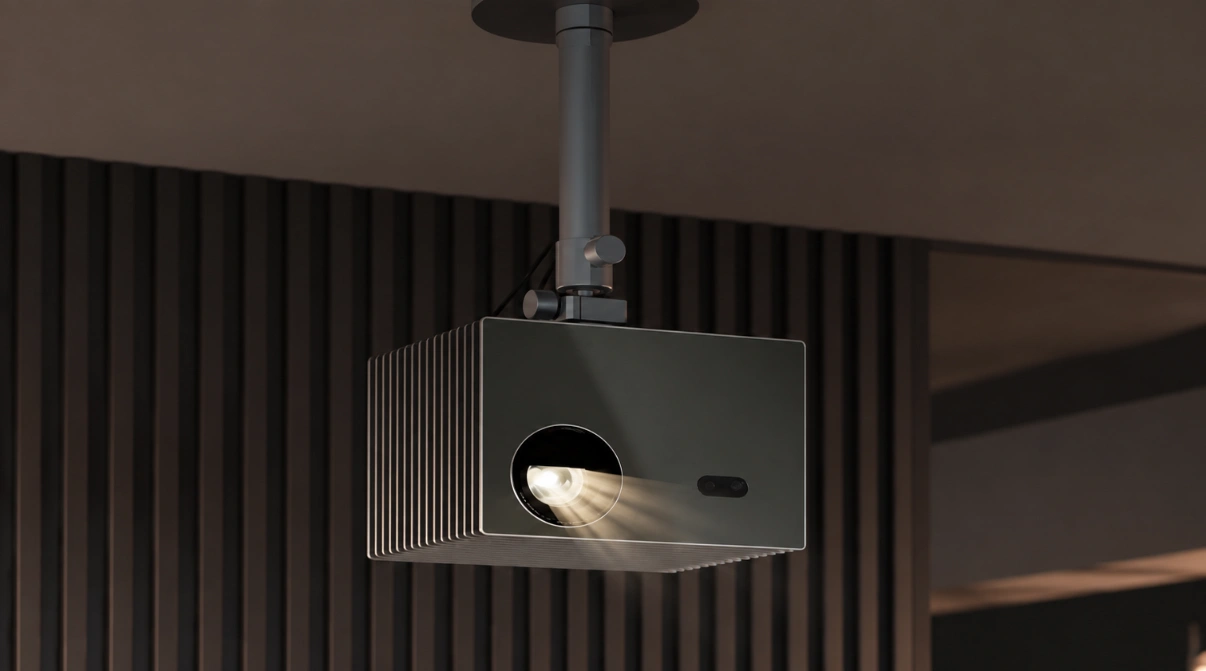
We see this happen all the time. A user buys a high-end Long Throw projector (one that mounts on the ceiling or sits on a coffee table) and pairs it with a Lenticular screen because they heard it was "good for daylight."
Here is the physics failure: A Long Throw projector shoots light horizontally, straight at the screen. A Lenticular screen's sawtooth structure is designed to block light coming from above and accept light from below. When a horizontal beam hits those "blinds," it slams directly into the black absorption layer.
The Result:
- Your image brightness will be cut by 50% or more.
- The picture will look muddy and dark.
- You might see weird shadows or "ghosting."
The Rule: Unless you have a UST (Laser TV), steer clear of standard Lenticular screens.
Why Fresnel is the "Soulmate" for Long-Throw Projectors
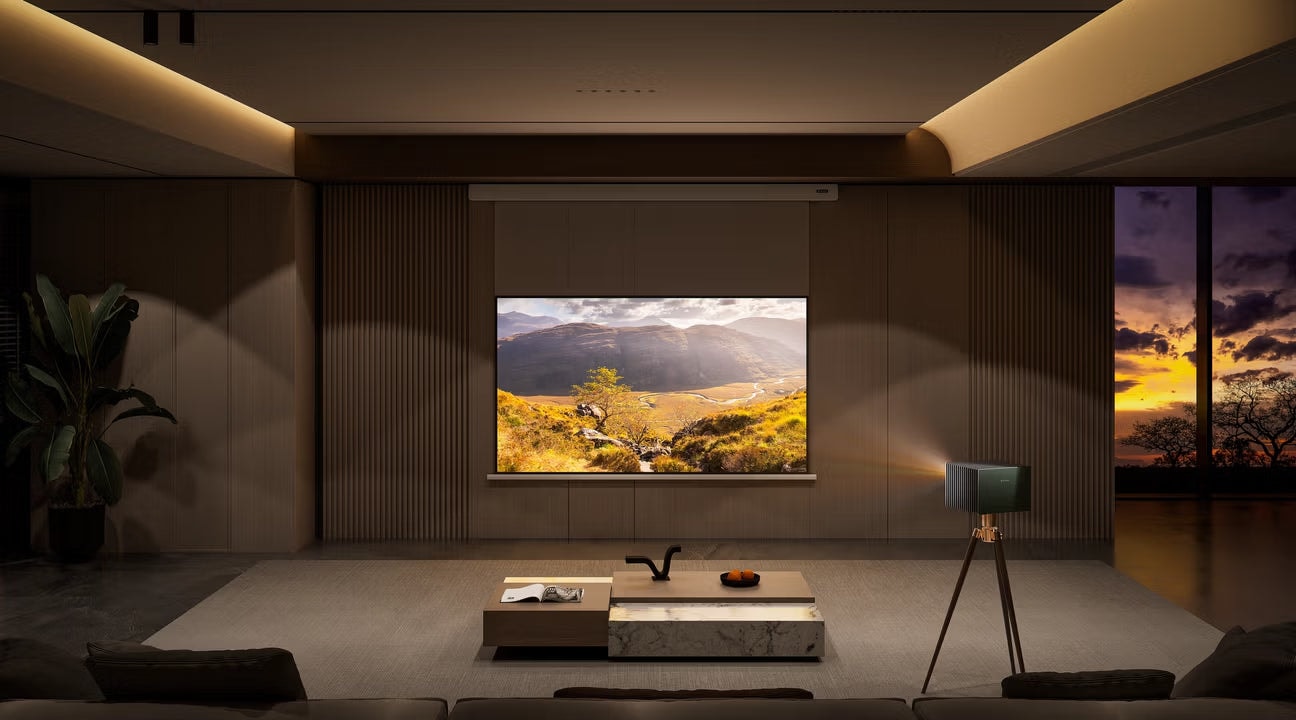
If you are using a standard or long-throw projector—especially a high-performance RGB Laser model—the Fresnel screen is your best friend.
This is especially true for the new generation of triple-laser projectors, like the AWOL Valerion Max.
When you have a projector that outputs incredibly pure RGB laser light and high brightness (3000+ Lumens), you want a screen that protects that quality.
- Preserving the "Punch": The high gain of a Fresnel screen works in harmony with the high brightness of the AWOL Valerion. It ensures that the HDR effects (bright highlights, deep shadows) hit your eye with the intensity the director intended, rather than getting absorbed by a low-gain gray screen.
- Color Purity: RGB lasers produce colors that are purer than traditional LED or bulb projectors. Fresnel structures are excellent at reflecting these specific wavelengths without shifting the color tone, giving you that "glossy," high-end TV look.
- Daylight Viewing: The combination of a high-lumen laser projector and a light-focusing Fresnel screen is the only setup that truly allows for casual viewing during the day without blackout curtains.
Conclusion: Which One Should You Buy?
Don't overcomplicate it. Your choice is dictated by your projector type and your room.
Use this simple checklist:
Scenario A: You have a UST (Ultra Short Throw) Projector
Your Choice: Lenticular / PET Crystal Screen.
Why: It is the physically correct match for the steep angle of projection.
Scenario B: You have a Long Throw Projector
Option 1 (Living Room / Ambient Light): Fresnel Screen (Hard Screen).
Why: It maximizes brightness, fights side-window light, and unlocks the full potential of your laser engine.
Option 2 (Dedicated Dark Theater): White Matte or Grey Screen.
Why: If you have total light control (a "bat cave"), you don't strictly need ALR. But if you turn the lights on, the image will vanish.
Building a home theater is an investment. Make sure you aren't bottlenecking your powerful projector with the wrong sheet of fabric.
FAQ
Q: Can I use a Fresnel screen with a ceiling-mounted projector?
A: Yes! However, because Fresnel screens are directional (they have an "up" and "down"), you typically need to mount the screen upside down if your projector is ceiling mounted. This ensures the "lens" structure focuses the light down to your eyes, not up to the floor. Always check the manual for your specific screen.
Q: Why are Fresnel screens usually sold as "Hard Screens"?
A: The precise semi-circular optical structure is difficult to print onto a soft, rollable fabric without distorting it. To maintain the optical precision required for that high gain and focus, most high-quality Fresnel screens are rigid panels.
Q: Is a Fresnel screen better than a white wall?
A: In a dark room, a white wall is "okay." In a room with any light, a Fresnel screen is infinitely better. A white wall scatters light everywhere, destroying contrast. A Fresnel screen directs the light to you, preserving black levels and color saturation even when lamps are on.
Member Benefits
Bring Your Cinema Experience Further
Subscribe and receive a $50 Welcome Benefit plus 4 pairs of 3D glasses, along with exclusive Valerion updates.

Points & Rewards

Member Pricing

Early Access

Priority Support
Discover More Insights