How Many Watts Does a Projector Use? Complete Power Consumption Guide
July 16, 2026
Did you halt your investment in a projector because of how many watts a projector uses? Many people assume modern home theater projectors are massive energy hogs that produce excess heat, drawing direct comparisons to old-school classroom equipment.
Figuring out whether a projector uses a lot of electricity and its true running cost requires looking at real-world data, not just theoretical limits. To help you figure out exactly how many watts a projector uses, this guide will delve deeply into common misconceptions, real power usage by category, how to calculate your home theater projector electricity cost, and an objective look at projector vs TV power consumption.
What Affects Projector Power Consumption?
Before diving into the numbers, determine how much electricity a projector uses with underlying factors that dictate a projector’s energy draw. Several variables influence exactly how much power your unit will use at any given time:
- Light Source Technology: Lamp-based models traditionally draw the most power, while modern laser and LED models are far more efficient.
- Operating Mode: Running a projector in “Eco Mode” uses significantly less power than “High Altitude” or “Maximum Brightness” modes.
- Image Brightness (Lumens): Pushing a projector to display extremely bright images for daytime viewing requires more energy.
- HDR Processing: Displaying High Dynamic Range (HDR) playback may increase power consumption on some projectors depending on brightness settings and manufacturer design.
- Fan Speed: Cooling requirements based on room temperature or brightness settings can slightly affect total power consumption, although fan motors typically account for only a small portion of a projector's overall energy use.
How Many Watts Does a Projector Use? Understanding Wattage vs. Electricity Cost
When calculating electricity usage, “Wattage” is not exactly the same as “Energy Consumption” (kWh) or “Brightness” (Lumens).
To make this easy to understand, imagine you are watering a garden with a hose:
- Wattage (Watts) is the width of the hose, it is simply the rate at which power (water) is flowing right now.
- Energy Consumption (kWh) is the total amount of water that has filled the pool over time.
- Brightness (Lumens) is how wet the garden actually gets.
Keep in mind that higher numbers don't always mean better. Projector wattage varies depending on the technology. An inefficient projector might have high wattage (a wide hose), but it sprays the water everywhere, meaning it doesn't actually project a brighter image. Modern improvements in luminous efficiency act like a high-pressure nozzle, allowing many projectors to produce significantly more brightness while using a much smaller hose (less power).
What Do the Different Numbers on the Specification Sheet Mean?
When people buy a new projector, the long list of specifications can be confusing. Here is what those power numbers actually mean:
- Maximum/Rated Power: This is the highest amount of power the projector can draw when every component operates at peak capacity. If you use the projector regularly in a standard room environment, it will rarely hit this limit.
- Typical Operating Power: This is the actual, average power drawn during everyday viewing with varied bright and dark scenes. Manufacturers usually measure this using standards applicable to energy reporting.
Testing typical power vs maximum power, it often relies on international testing methods involving dynamic video sequences.
Typical Projector Wattage Ranges by Category
To accurately determine your energy costs, you first need to identify the type of projector you own. Typical projector wattage ranges from as little as 15 watts to over 400 watts depending on the hardware.
| Projector Category | Typical Power Draw | Technology Notes |
|---|---|---|
| Pico & Portable | 15W – 50W | Prioritizes battery life over peak brightness. |
| LED Home Entertainment | 50W – 150W | Great for dark bedrooms; highly energy efficient. |
| 4K Home Theater | 130W – 400W+ | Wide range depending on processing and brightness output. |
| Modern RGB Triple-Laser | 130W – 300W | Modern laser projectors are far more efficient than older lamp-based models with comparable brightness. |
Does a Projector Use a Lot of Electricity? (Calculating Real Running Costs)
To find out how much electricity your projector uses and the actual financial impact, you can calculate electricity usage by using a straightforward equation:
Daily Cost = (Watts ÷ 1000) × Hours used per day × Local electricity rate
To determine your monthly bill, we can expand the formula. Let's use an illustrative example based on the latest EIA average residential rate in the US, which is approximately 18.83 cents/kWh. (Always use the latest published average residential electricity rate for exact math). If you run an efficient laser projector (140W) for 4 hours a day, your monthly cost formula looks like this:
Monthly Cost = 30 × [(Watts ÷ 1000) × Hours used per day × Local electricity rate]
Monthly Cost = 30 × [(140 ÷ 1000) × 4 × 18.83] = 316.34 cents = $3.16
This calculates to 316.34 cents, or roughly $3.16 per month.
Does a projector use a lot of electricity? Even with heavier usage, many home theater projectors' electricity cost would be roughly $5–$15 per month to operate under typical viewing habits. This is often comparable to, or less than, a single basic streaming subscription!
Projector vs. Big-Screen TV: The “Watts-Per-Square-Inch” Decision Boundary
Many buyers face a dilemma when aiming for a 100-inch or larger screen: Should I buy a massive TV or a projector? Understanding projector electricity usage compared to TV energy draw is crucial for making an informed decision.
How Screen Size Affects Power Usage (The Flashlight vs. The Lightbulb)
When it comes to TV vs projector electricity cost, screen size changes the rules.
Think of a projector like a high-powered flashlight. If you shine a flashlight against a bedroom wall and take two steps back, the circle of light gets much bigger. However, the flashlight doesn't suddenly drain more battery power just because the image is larger. The power draw remains constant. Projecting a 150-inch image draws essentially the same amount of power as an 80-inch image.
A TV, on the other hand, is like a mosaic of lightbulbs. If you want a bigger mosaic, you literally have to plug in more bulbs. TV power consumption generally increases with screen size, especially in high-brightness HDR modes. As a television panel gets larger (such as 85-inch or 98-inch models), it requires significantly more backlight zones or self-lit pixels to fill that space.
Energy Efficiency Per Screen Size (Watts-Per-Square-Inch)
To properly evaluate power per display area, we can look at "watts per square inch." While this is an illustrative comparison rather than an industry-standard metric. To measure the energy usage of the projector and TV, the metric of watts per square inch is used. It's how many watts does it take for each to show a square inch of the image?
Formula to calculate watts per square inch = Watts ÷ Screen size (Sq. in)
- Massive TV: A premium 98-inch LED/OLED TV commonly draws 280W–330W. This means it consumes roughly 0.07 W/sq. in.
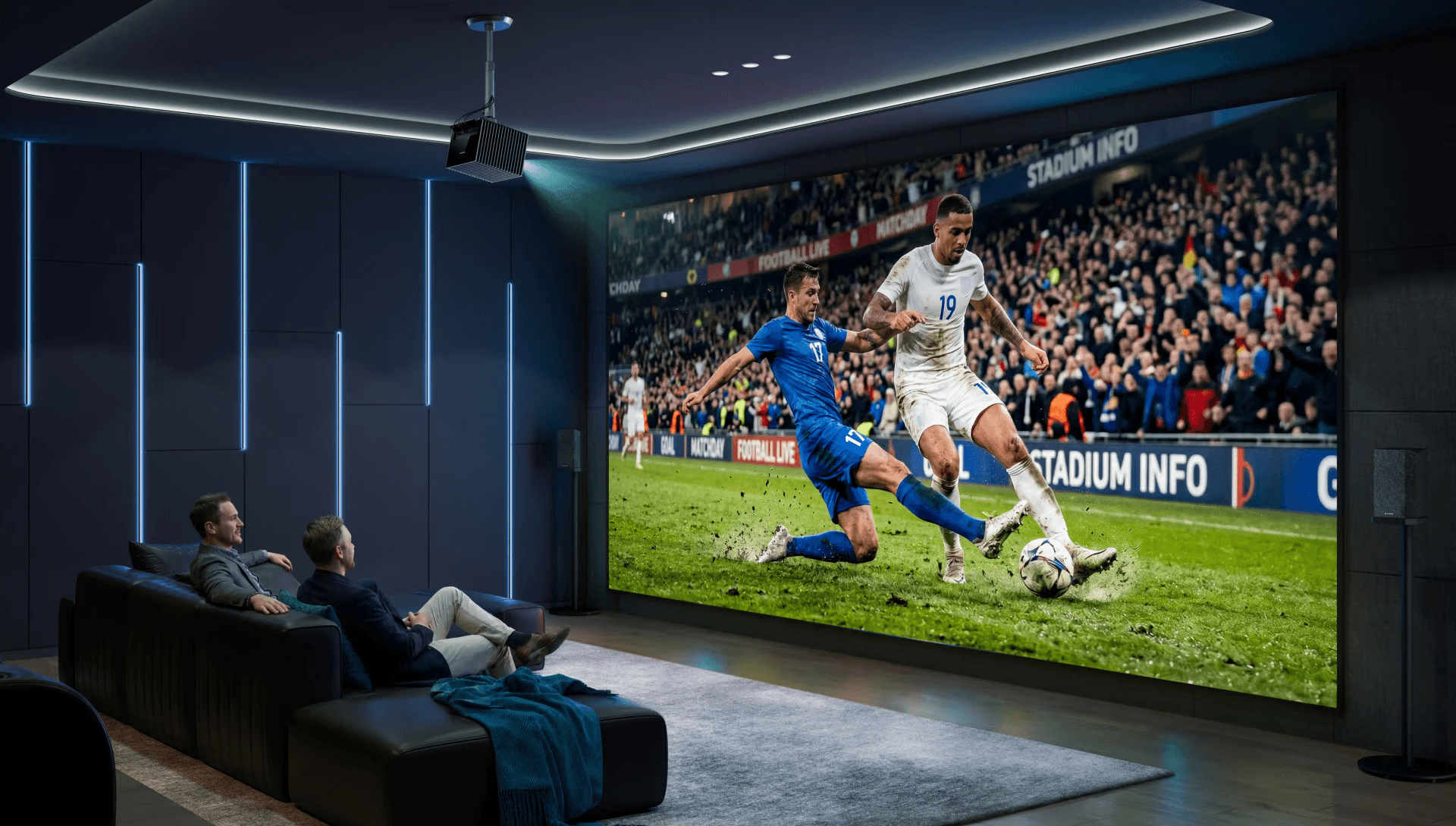
- Large-Format Projector: Based on typical manufacturer specifications, a highly efficient 120-inch RGB triple-laser projector drawing approximately 136–150 watts equates to roughly 0.02 W/sq. in. This comparison is intended as an illustrative efficiency metric rather than an industry-standard measurement.
Screens under 85 inches are typically highly energy-efficient as TVs, but projectors become efficient once you cross the 100-inch boundary. This is why many home theater buyers consider modern RGB laser projectors when aiming for cinematic screen sizes without significantly increasing household energy consumption. Highly efficient projectors such as AWOL Valerion Pro 2, that projects up to 300” screen size while projecting a 4K image without any lag.
Standby Power, Eco Mode, and Practical Energy-Saving Tips
You generally do not need to worry about “Phantom Load” (the power electronics consume when turned off but plugged in). Modern global energy regulations, such as ErP Lot 6, strictly restrict standard standby power to under 0.5W.
How Do Energy Saving Modes Work?
- Eco Mode: This power-saving setting reduces the projector's power consumption by lowering the laser output or lamp power, which slightly reduces peak brightness. (Note: It does not reduce computing or processing power).
- Smart/Dynamic Black: This mode dynamically adjusts the projector's light output to match dark scenes, deepening contrast while saving energy.
But this doesn’t reduce the difference between lamp and laser projector. Laser projector will usually have more lifespan.
Practical Energy Saving Tips:
- Enable Dynamic/SmartEco modes for evening viewing.
- Keep fan exhaust vents perfectly clear of dust to improve cooling efficiency.
- Utilize auto power-off timers to prevent the projector from running to an empty room.
- Ensure proper spatial ventilation so the fans do not have to work overtime, although fans only make a minor contribution to the overall power draw.
- Perform regular maintenance (like cleaning filters) to maximize airflow.
Frequently Asked Questions
Can I run a home theater projector on a portable solar power station?
Yes. If you have a standard 500Wh portable power station, you can easily run a highly efficient 140W laser projector for a 3-hour outdoor movie night, even after accounting for typical inverter energy losses.
How much electricity does a projector use?
Most projectors consume between 50 and 400 watts, depending on the specific technology, brightness settings, and model. Portable LED projectors typically use the least power, while high-brightness laser or older lamp-based projectors consume more.
Do projectors use more electricity than TVs?
It entirely depends on the screen size and the models being compared. Small to medium-sized TVs generally use less electricity than most projectors. However, for very large screen sizes (100 inches or more), projectors can be a far more energy-efficient option than equivalently sized TVs.
Should I unplug my projector when not in use?
You don't need to unplug your projector just to save electricity, since standard standby mode uses less than 0.5W of power. It is only recommended to unplug your projector during severe thunderstorms to protect it from power surges.
Do higher lumen projectors always use more watts?
Not necessarily. In the real world, the internal technology matters more than raw watts. A modern 3000-lumen RGB triple-laser projector uses significantly fewer watts than an older 1500-lumen lamp projector due to its superior luminous efficacy.
Does screen size affect projector power consumption?
No. The projected screen size itself does not directly affect power consumption. Electricity usage depends purely on the projector's internal settings, especially the light source brightness and operating mode.
Does a 4K projector consume more electricity than a 1080p projector?
Not necessarily. While some 4K projectors consume more power due to advanced image processing and higher baseline brightness requirements, actual power consumption always comes down to the specific model and the efficiency of the light source technology.
What is the difference between power rating and power consumption?
A power rating (watts) indicates the rate or amount of power the projector requires while actively operating, while power consumption (kWh) measures the total amount of electricity used over a given period of time.
Member Benefits
Bring Your Cinema Experience Further
Subscribe and receive a $50 Welcome Benefit plus 4 pairs of 3D glasses, along with exclusive Valerion updates.

Points & Rewards

Member Pricing

Early Access

Priority Support
Discover More Insights