Can we guarantee something about you? We can guarantee there is a disconnect between your modern 4K or 8K visuals and audio quality. We can guarantee that audio quality is often overlooked. But what if we are wrong about you? If we are, tag us on social media. How will you prove that we are wrong?
Just by comparing this guide with your audio quality to see if you are actually having the best audio quality so that you could enjoy a true-theater experience at home. We will delve deeper into DTS (Digital Theater Systems) Surround Sound, which is one of the world’s leading standards for digitally encoded, multi-channel audio, primarily competing with Dolby Atmos. To help you better understand, this guide will break down the three major DTS standards — DTS-HD Master Audio, DTS:X, and DTS Virtual:X, and discuss their functional differences in today’s home entertainment hardware. Let’s dive deeper into understanding the core principles of DTS Surround Sound technology.
The Foundation: DTS-HD Master Audio (The Standard for Fidelity)
Do you hear that the audio is not clear or detailed as the projector or TV specs suggest? This is due to lossy audio compression. On the other hand, when you have premier lossless audio coded with the DTS family, you get to experience in-depth audio, and even minute effects like leaves being crushed in the background could be felt. What is lossless audio?
It is decoded bit-for-bit at a high sampling rate of up to 192 kHz and with a bit depth of 24 bits, precisely as the original studio master recording. This quality differentiates premium media players by offering maximum clarity, dynamic range, and fidelity with eight discrete surround-channel audio. They are essential for you if you prioritize quality from Blu-ray discs and other high-capacity storage formats. Not all devices support DTS surround sound. Devices designed to handle high-fidelity media, such as the Valerion StreamMaster Plus Series, incorporate compatibility for DTS-HD Master Audio to ensure the highest possible audio playback quality from compatible sources.
The 3D Revolution: DTS:X (Object-Based Sound)
Is 3D audio better than HD audio? Yes. This next-generation audio is actually Object-Based Sound. So that you can experience sound with spatial characteristics beyond stereo speakers’ capabilities, such as dialogues and effects like the brushing of leaves and wind, and they all move fluidly in 3D space. It includes overhead space, regardless of your speaker configuration. But this audio codec requires a different format.
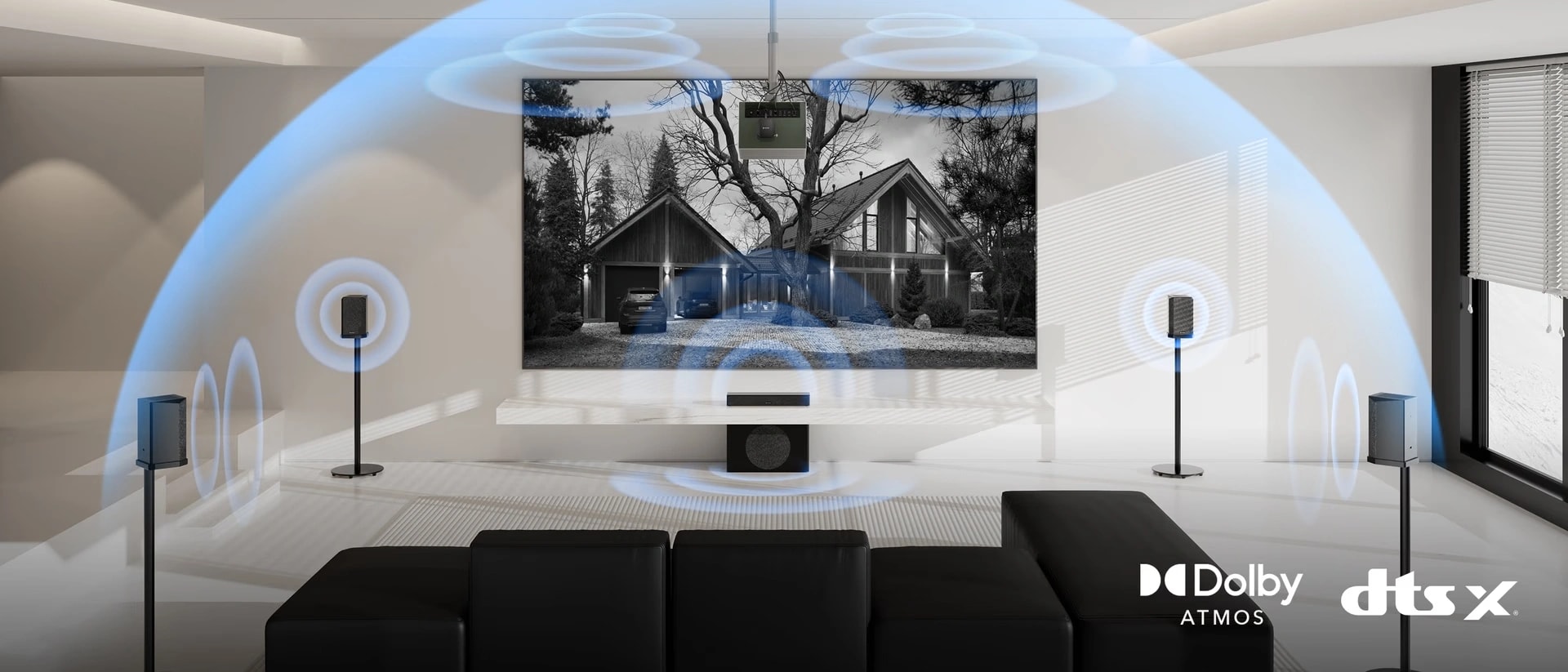
The DTS:X format doesn’t rely on fixed speaker channels. Instead, it places sound as “Audio Objects” within a complete 3D coordinate system. And you get to experience a truly immersive, multidimensional audio experience, allowing sound engineers to control and isolate sound objects, their placement, movement, and volume. But is your hardware compatible with object-based sound?
You can compare it with devices designed for dedicated 3D sound, such as the Valerion ThunderBeat Wireless Surround System (5.1.2/4.1.2) to utilize native DTS:X decoding.
Note: To have true 3D audio: “.2” channel count in audio configuration, which signifies dedicated height speakers required to render the verticality of the DTS:X mix completely.
The Smart Solution: DTS Virtual:X (The Virtualizer)
Do wires ruin the aesthetics of your setup? To experience true theater at home, you have to go through a lot of hassle setting up multiple speakers in a room. How can you avoid this yet? With DTS Virtual:X, the technology is designed primarily for all-in-one devices with constrained space.
Since this is a post-processing algorithm that uses software-assisted psychoacoustics to simulate a height-and-surround sound experience from a minimal speaker setup, such as a 2.0 or 2.1 channel setup, you experience a more expansive soundstage than a stereo could normally allow, without the need for up-firing or rear speakers. What if your sound bar is not compatible with DTS Virtual:X?
New sound bars don’t cost that much. Or you can just avoid trouble by having an integrated sound bar. Leading examples include Valerion VisionMaster Max 4K RGB and VisionMaster Pro Series projectors, which feature 2x12W DTS Virtual:X speakers.
Technology Application: Choosing Your DTS Implementation
Which is the best DTS Surround Sound technology for you? All three technologies — DTS-HD Master Audio, DTS:X, and DTS Virtual:X — have distinct advantages and disadvantages compared to one another. Here’s how to decide the best for you:
- For Uncompromised Lossless Quality: To have more than just a stereo experience with minimal compression and the best playback from physical media, devices should support DTS-HD Master Audio, like the Valerion StreamMaster Plus Series.
- For True 3D Object-Based Sound: For in-depth 3D sound with spatial rendering and minute environmental details, a multi-speaker system with high-channel count is required to support DTS:X decoding, i.e., Valerion ThunderBeat Systems.
- For All-in-One Immersive Sound: To save space and be practical while still experiencing surround sound and height effects, a single-unit device that uses the DTS Virtual:X algorithm is a good fit, such as Valerion VisionMaster projectors.
Whether you want to use streaming or disc, you are a sound engineer and need to dissect the movement, you want to experience audio with more detail than just mono or stereo, or you prefer an all-in-one solution, DTS could help you in that. For further assistance, your media sources and physical space define the choice from the family of DTS surround sound.
Conclusion
All three DTS technologies are designed to satisfy your distinct needs. Understanding audio standards is key to having the best experience and maximizing your home entertainment system's potential. For lossless audio, a more-than-stereo experience, and fidelity, DTS-HD Master Audio offers that. DTS:X lets you hear 3D object-based sound, enabling you to pinpoint movement in your living space from the media source. For simpler setups?
DTS Virtual:X technology provides an immersive experience with no setup hassle by leveraging psychoacoustic software. Now, can you answer this question? Was our guarantee in the beginning correct? If not, post it on social media and tag us. If yes, check the specifications of your existing or soon-to-be-purchased equipment for DTS support to ensure you get the best possible audio experience.