You've invested in a great receiver, quality speakers, and a projector that does justice to your favorite films, so why does dialogue still sound muddy? Why does every explosion dissolve into a wall of booming chaos?
The answer almost certainly isn't your equipment. It's your room. Acoustic panels for home theater aren't just a nice upgrade; for most spaces, they're the missing piece that makes everything else actually work.
Key Takeaways
- Acoustic treatment and soundproofing are two completely different things. Panels absorb internal reflections, but they don't stop sound from escaping the room.
- Bare drywall, hard floors, and parallel walls create "slap echo" that smears dialogue and muddies the soundstage.
- Every home theater needs three treatment types: broadband absorbers, bass traps, and diffusers.
- Panel placement matters as much as panel quality. The mirror trick removes the guesswork from finding first reflection points.
- Cheap foam only catches high frequencies. For real results, you need dense fiberglass or mineral wool panels.
- Your visual environment and your acoustic environment are deeply interconnected. Dark fabrics and a quality screen both contribute to image and audio performance.
Acoustic Treatment vs. Soundproofing
What Is the Difference Between Sound Isolation and Acoustic Treatment?
These two terms get mixed up constantly, but they describe entirely different problems.
Soundproofing — technically called sound isolation — is about stopping sound from traveling between rooms. Think thick walls, decoupled framing, added layers of drywall, and damping compounds like Green Glue. It's largely a construction-phase solution, expensive to retrofit, and best addressed when you're planning and building a dedicated home cinema setup.
Acoustic treatment, by contrast, has nothing to do with the outside world. It's entirely focused on what happens inside your room, specifically, how sound waves behave after they leave your speakers. Acoustic panels fall into this category.
The two work on different physics entirely, which is why you can't substitute one for the other.
Why Acoustic Panels Won't Stop Sound from Leaving the Room
This is the most common misconception in home theater acoustics, and it leads to real frustration. Here's the simple version: fabric-wrapped panels are designed to absorb mid- and high-frequency sound energy so that bouncing reflections don't muddy what your ears hear inside the room. They are not designed to block sound from passing through walls.
According to acoustic engineering principles cited by Acoustics Today, stopping bass transmission through a wall requires structural mass and decoupling — essentially building one structure inside another. A panel hanging on your wall cannot do that. The two solutions solve different problems entirely, and confusing them will leave you disappointed.
Why Your Bare Walls Are Ruining Your Audio Clarity
How Slap Echo and Sound Reflections Distort Movie Dialogue
When sound leaves your speakers, it doesn't travel in just one direction, it radiates outward in every direction. In a room with bare drywall, hard flooring, and a flat ceiling, those sound waves bounce off every surface and arrive at your ears a few milliseconds after the direct sound from the speakers.
Your brain receives the same audio information twice, slightly staggered in time. The result is a smeared, unfocused sound: dialogue loses clarity, instruments lose definition, and the entire sonic picture feels blurry. This effect is called slap echo, and it's the primary acoustic enemy of the home theater.
The fix isn't better speakers. The fix is stopping those reflections before they reach you.
The Role of the Center Channel in an Untreated Space
Many home theater enthusiasts spend considerable money chasing a better center channel speaker, swapping one model after another, without ever solving the real problem.
Here's why it matters: the center channel carries approximately 70% of a film's dialogue. In an untreated room, its output bounces off the front wall, side walls, and ceiling before reaching your seat, arriving as a diffuse wash of sound rather than a sharp, focused voice. No speaker, regardless of price, can overcome that.
Once treatment is in place, the improvement is immediately obvious. Vocals lock into position with a precision that no equipment upgrade can match, and it's often the single most dramatic change a homeowner notices after treating their room.
The 3 Types of Acoustic Treatments Every Home Theater Needs
Not all acoustic panels do the same thing. A well-treated home theater uses three different types of treatment, each targeting a specific problem.
Acoustic Absorbers (Broadband Panels) for Mid and High Frequencies
Broadband absorbers are the workhorses of acoustic treatment. Made from dense materials like compressed fiberglass or mineral wool, these panels work by converting sound energy into a tiny amount of heat through friction inside the material; the sound goes in, but it doesn't come back out.
Thickness is what determines how well they work. A 2-inch panel handles upper-mid and high frequencies. A 4-inch panel reaches deeper into the lower midrange, where a lot of dialogue and vocal texture lives. Placed at key reflection points around the room, broadband absorbers are what transform a boomy, echoing space into one where you can actually hear what's being said on screen.
Bass Traps for Taming Corner Distortion and Booming Lows
Bass is a completely different challenge. Low-frequency sound waves are long and powerful, and they interact with the dimensions of your room to create standing waves, patterns where certain bass frequencies are boosted in some spots and cancelled in others. The result is that bass sounds thunderous from one seat and thin from another, regardless of your speaker settings.
Low-frequency energy naturally accumulates in the corners of a room, specifically the tri-corners where two walls meet the ceiling or floor. This is why floor-to-ceiling bass traps placed in all four corners are the most effective treatment for controlling booming, uneven bass across the entire listening area.
Diffusers for Maintaining Soundstage Energy
Here's a mistake many people make: they assume that more absorption always means better sound. It doesn't. Cover every surface with absorption panels and you'll end up with what acoustic engineers call a "dead room": a space that feels acoustically lifeless, claustrophobic, and completely wrong for a cinematic experience.
This is where diffusers come in. Instead of absorbing sound, diffusers scatter it in multiple directions. The sound energy is still distributed, it just isn't bouncing straight back at you. The result is a sense of spaciousness and dimension that makes surround sound feel genuinely immersive rather than flat and confined. On rear and upper side walls, a combination of absorption and diffusion is what keeps a room sounding like a theater rather than an anechoic chamber.
The Step-by-Step Placement Playbook for Acoustic Panels
Knowing what panels to buy is only half the problem. Knowing where to put them is what makes the difference between treatment that works and panels that just decorate your walls.
How to Find First Reflection Points Using the Mirror Trick
You don't need expensive measurement equipment for this - just a mirror and a friend.
Sit in your primary listening position. Have someone slowly slide a mirror along the side wall, moving from the front of the room toward the back. The moment you can see a speaker reflected in the mirror from where you're sitting, mark that spot on the wall. That is your first reflection point. This is the exact location where sound bouncing off that wall reaches your ears. Repeat this on the opposite side wall, and on the ceiling directly above the midpoint between your speakers and your seat.
These three points are your highest-priority placements. Broadband absorbers mounted here will have a more dramatic effect on sound clarity than panels placed anywhere else in the room.
Treat the Front Wall Behind Your Projection Screen
The front wall — the area behind and flanking your left, center, and right speakers — needs absorption to prevent what's called front-stage smearing, where the sounds from your three front speakers blur together into an indistinct mass rather than a precise, three-dimensional image.
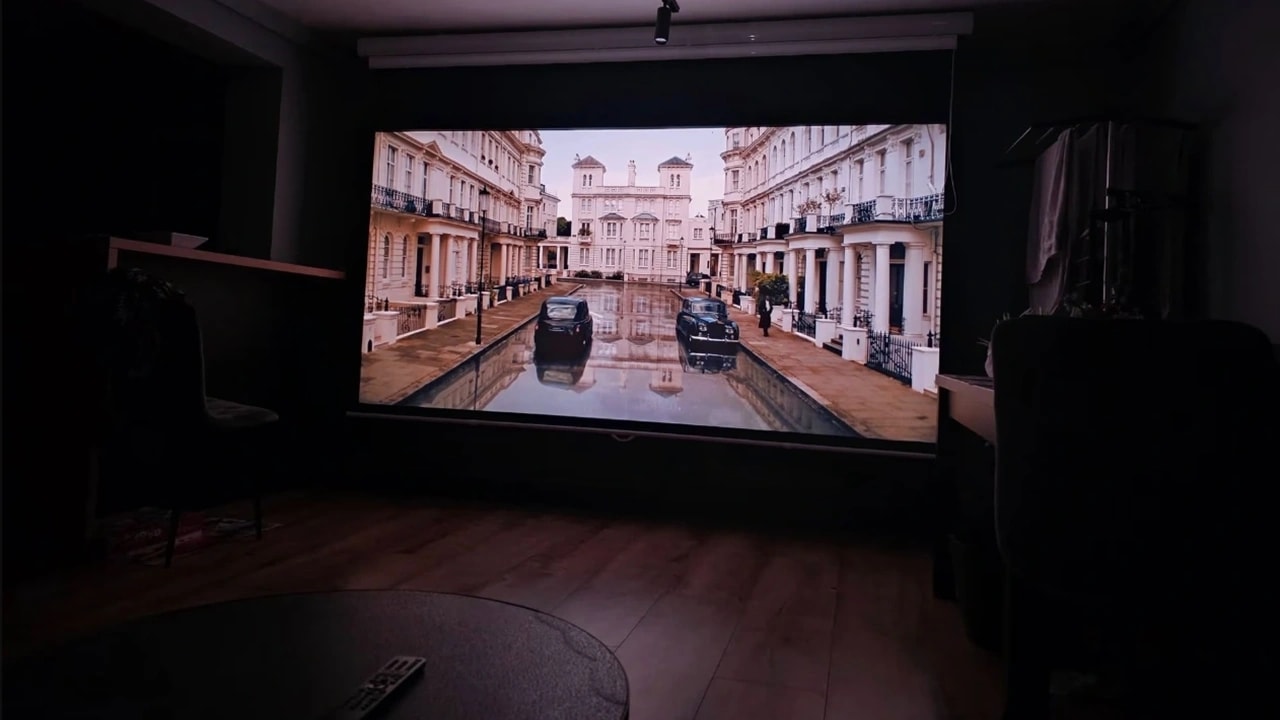
It's also worth noting that what you project onto matters acoustically, not just visually. The difference between projecting onto a dedicated screen versus bare drywall or paint is meaningful in both dimensions. A properly tensioned matte screen can be positioned to allow treatment panels to flank it cleanly on both sides, giving you an optimized front wall that handles both image and audio correctly.
Optimize the Side and Rear Walls for Immersive Layouts
Side walls at first reflection points get broadband absorbers; this is where the mirror trick points you. For the rear wall, pure absorption is actually the wrong choice. It flattens the depth and spaciousness that make surround sound effective. A mix of absorption and diffusion on the rear wall preserves the sense of envelopment that makes a good surround mix feel like you're in the scene rather than sitting in front of it.
As your speaker layout grows more complex, moving toward Dolby Atmos configurations such as the 5.1.2 or the 4.1.2 , the interaction between height channels, rear channels, and room surfaces becomes increasingly critical. In these layouts, ceiling treatment and upper side wall treatment take on greater importance, as height information is some of the most fragile audio content to preserve accurately.
Designing a Flawless Audio-Visual Environment
Why Acoustic Panel Color Choice Matters for Projector Performance
Acoustic treatment and projector performance are more connected than most people realize. Panels placed near the screen don't just absorb sound, they also interact with the light coming from your projector.
A light-colored panel near the screen will reflect projector light back toward the audience, reducing contrast and washing out shadow detail in dark scenes. The fix is simple: use dark, light-absorbing fabrics — charcoal, black, or dark velvet — for any panels within the projector's throw path. This choice reinforces a broader principle: the wall colors and surfaces in your home theater should be dark and non-reflective throughout, so that light stays on the screen where it belongs.
Balancing High-Density Acoustics with a Massive Cinematic Screen
Once your room's reflections are controlled, bass is tamed, and you've avoided over-damping, you've created something genuinely special: a space where the sound behaves exactly as the director intended. Now it's ready for a visual centerpiece that can match it.
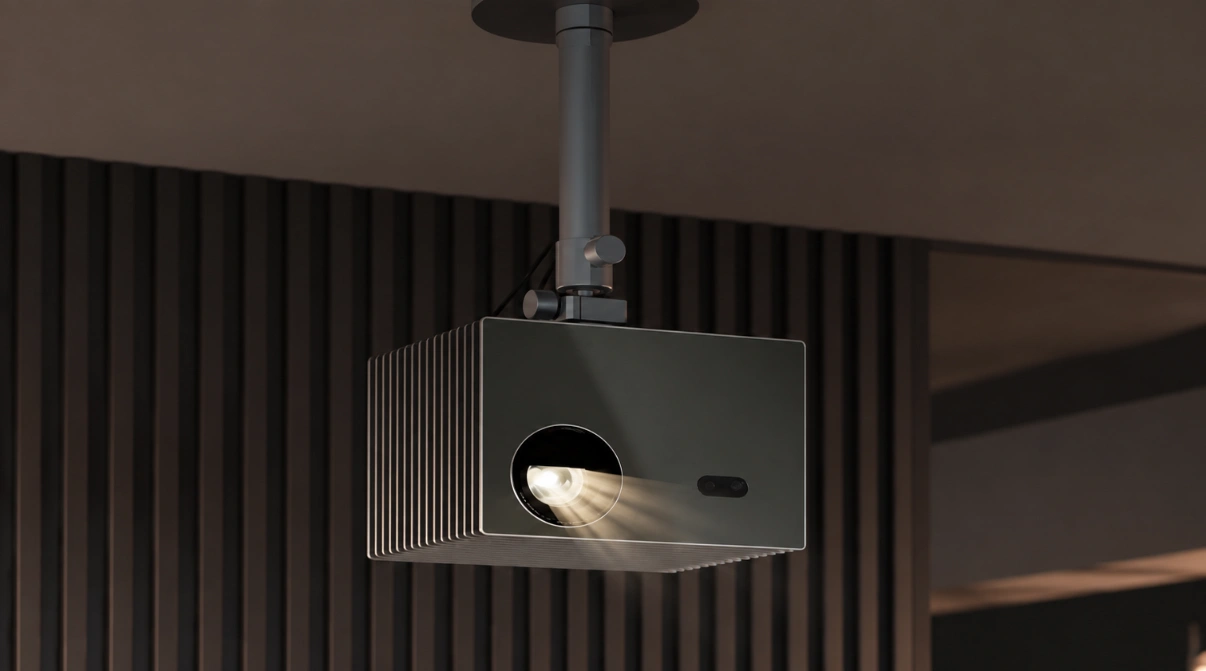
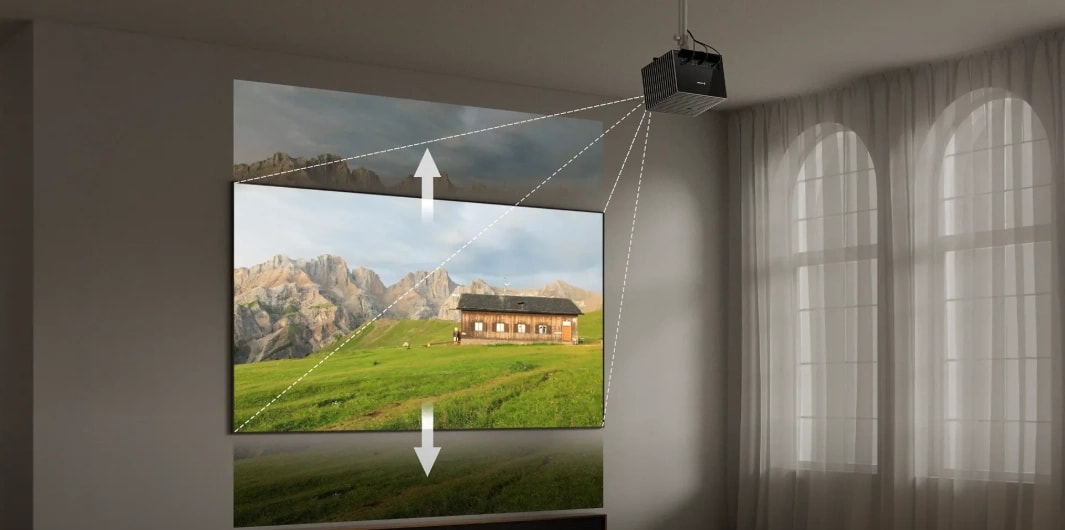
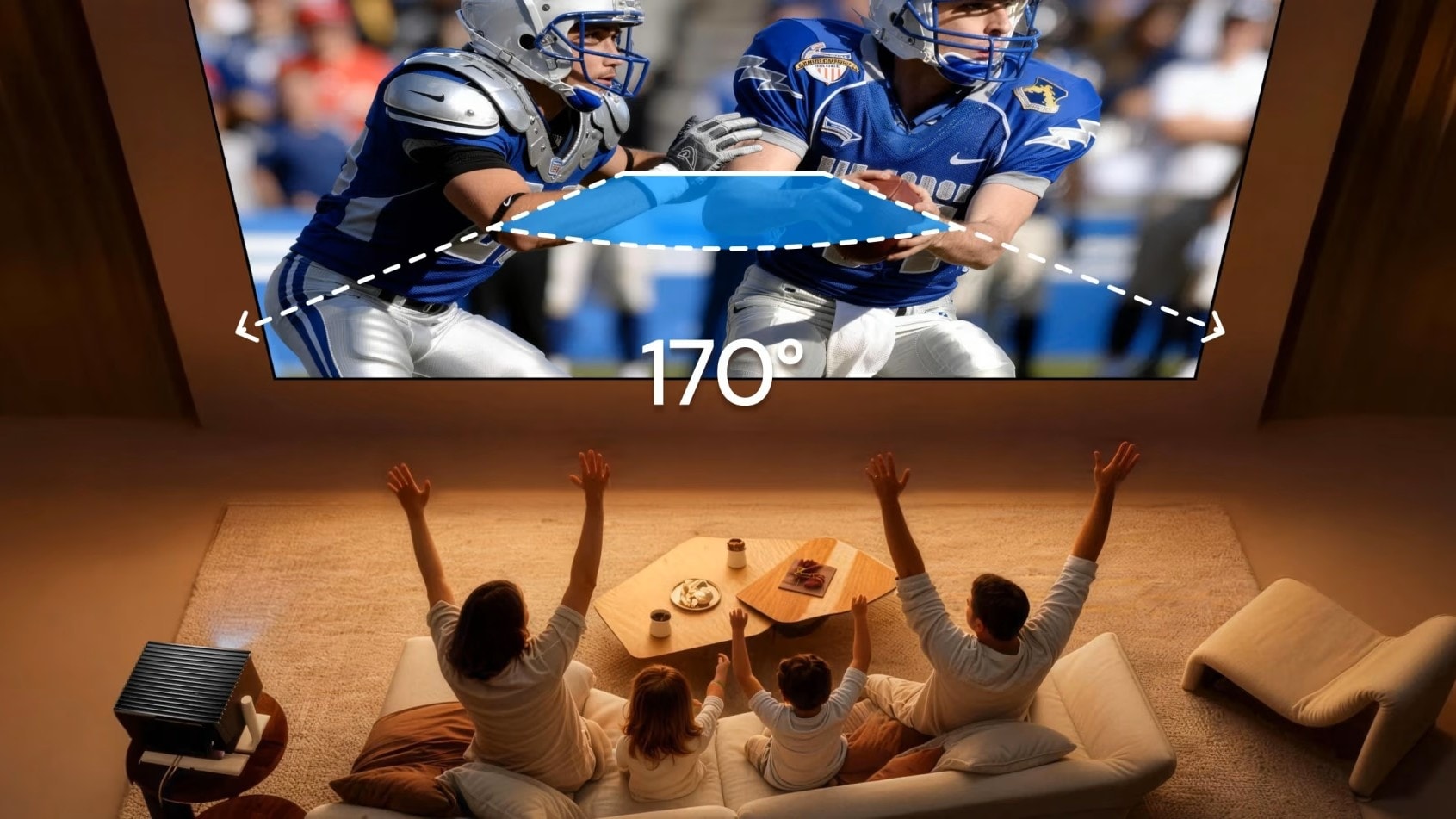
The Valerion Max paired with a Valerion 100''–220'' Matte White Screen sits perfectly within a treated front stage. The contrast performance of a triple laser source, with its wide color gamut and deep blacks can only be fully appreciated in a room where ambient light scatter has been eliminated and the acoustic environment isn't competing with the visual one.
In an untreated room, both the image and the sound are compromised. In a properly optimized room, both reach their full potential simultaneously.
DIY vs. Pre-Fabricated Acoustic Panels
Why Cheap Acoustic Studio Foam Fails in Home Theaters
Walk through any online marketplace and you'll find racks of thin foam tiles - the "egg crate" style - marketed as acoustic treatment for studios and home theaters. They don't work, at least not in any meaningful way.
The physics is straightforward: thin foam can only absorb very high frequencies, the kind associated with sibilance and surface-level harshness. It has essentially no effect on the 200Hz–2kHz midrange range where dialogue lives, and it provides zero meaningful bass control.
Independent acoustic measurements consistently show that these foam products function as surface decoration rather than genuine treatment.
Choosing Fabric-Wrapped Panels or Building Your Own DIY Frames
There are two legitimate paths forward. The first is buying professionally built panels constructed around an Owens Corning 703 or mineral wool core, wrapped in acoustically transparent fabric. The second is building your own: DIY frames filled with the same materials and wrapped in breathable fabric deliver acoustically identical results at roughly one-third the cost.
Aesthetics matter too, especially in shared living spaces. Custom-printed acoustic panels featuring movie posters or artwork are a popular option that tends to survive household negotiations considerably better than bare fabric rectangles. Whether you buy or build, the core material is what does the work, and that material needs to be dense fiberglass or mineral wool, not foam.
FAQs on Acoustic Panels for Home Theater
Are acoustic panels good for home theater?
Yes, they address the root cause of muddy dialogue, boomy bass, and a diffuse soundstage, rather than masking symptoms with equipment upgrades. No speaker or receiver upgrade can compensate for a room that works against you.
Where to put acoustic panels in a home theater?
Start with first reflection points on both side walls (use the mirror trick to find them exactly), then treat the front wall beside your speakers. Place floor-to-ceiling bass traps in all four corners. Use a mix of absorption and diffusion on the rear wall rather than pure absorption.
How to soundproof a home theater?
Acoustic panels cannot soundproof a room. True sound isolation requires structural solutions: decoupled walls, added mass, and ideally a room-within-a-room construction. These are best addressed during the build phase of a dedicated space, not after the fact.
What are the disadvantages of acoustic wall panels?
Over-treatment is the most common risk; a room with too much absorption sounds unnaturally dead and flat. Randomly placed panels provide limited benefit regardless of quality. And fabric-wrapped panels offer minimal bass control without significant thickness or proper corner bass trapping in place.