Inflatable Projector Screen: How to Choose the Right One
November 6, 2026
Choosing the right inflatable projector screen comes down to finding the right size for your yard, matching it with your projector, and picking an inflation design that fits your routine.
When shopping for an outdoor inflatable movie screen, there is much more to consider than just the advertised dimensions, including whether it uses a silent sealed-air frame or a continuous blower, what material the viewing surface uses, and whether it supports front or rear projection. This guide breaks down how these screens work and how to choose the best blow up projector screen for your viewing conditions.
What Is an Inflatable Projector Screen?
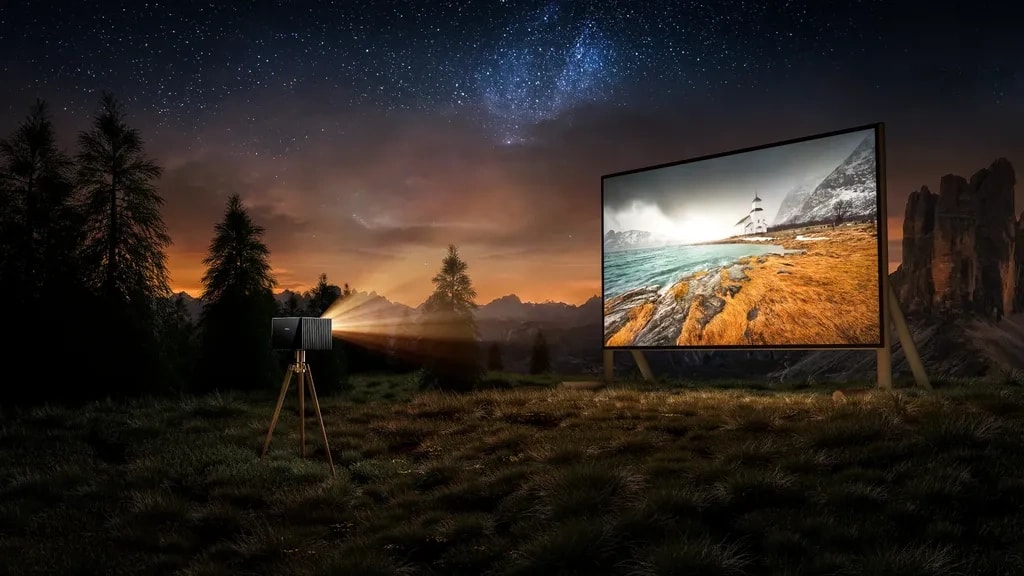
An inflatable movie screen uses an air-filled frame to hold a projection surface upright without a rigid metal stand. Just like a traditional indoor screen, an inflatable screen reflects the image beamed from a projector.
Inflatable screens fall into two main categories: models that require continuous airflow from a blower and models built with a sealed-air design. When buying an outdoor inflatable movie screen, remember that a standard screen listing does not automatically include a projector, speakers, or media player unless you specifically purchase a complete bundle.
Check Whether the Screen Needs a Blower Running
Before comparing screen sizes, check how the frame stays inflated during your movie. The difference between continuous-airflow and sealed-air models directly impacts noise levels, power management, and setup convenience.
|
Design |
What to Check Before Buying |
|
Continuous-AirFlow |
Whether the blower must remain connected throughout viewing |
|
Power requirements |
|
|
Operating sound |
|
|
Sealed-Air |
Inflation equipment |
|
Valve operation |
|
|
Air-retention guidance |
|
|
Whether adjustments may be needed once its sealed |
A traditional blow up projector screen that relies on continuous airflow adds constant blower noise to your evening. Because the fan must run nonstop, you also have to route an extension cord to an outdoor power outlet and position speakers carefully to overpower the motor hum.
We designed the AWOL Valerion Inflatable Outdoor Movie Screen with a sealed-air frame that holds pressure for up to 72 hours so you can inflate it in the dusk and host a silent double feature after dark without running power cords to a blower. Keep in mind that while a sealed-air inflatable movie screen does not need continuous power during the show, your projector, speakers, and streaming devices will still need their own power source or battery station.
Choose by Viewable Size, Then Measure the Whole Setup
Picture Size and Frame Size Are Different Measurements
Manufacturers do not always advertise dimensions the same way on product pages. Some highlight the diagonal viewing area in inches, while others list the total exterior frame width or height in feet. Compare these four core measurements before buying so you know exactly what will fit in your space:
- Diagonal Picture Size: This indicates the nominal size class of the viewing surface, measured diagonally from one corner of the white projection fabric to the opposite corner. Two screens with the same 200-inch diagonal will have different shapes if they use different aspect ratios, for example, a 200-inch 16:9 widescreen is wider and shorter than a 200-inch 4:3 screen.
- Aspect Ratio: The aspect ratio is the proportional relationship between the width and height of the viewing area. Having the same aspect ratio does not mean two screens are the same physical size.
- Viewing Width and Height: These measurements give the exact horizontal and vertical dimensions of the reflective viewing fabric itself, helping you confirm how large the actual image will appear.
- Overall Frame Dimensions: This measures the total physical footprint of the unit from outer edge to outer edge, including the reflective screen, black masking borders, and inflatable air tubes. A 200-inch screen such as the AWOL Valerion Matte White Screen has a much smaller total footprint than a 200-inch inflatable projector screen because of the thick inflatable frame.
Because a listing advertised in feet often describes the overall frame dimensions rather than the viewable picture, always compare the exact viewing width, height, and diagonal size before assuming a larger advertised number delivers a bigger image.
Make Room for the Screen, Projector, and Audience
When mapping out your backyard cinema for movies or live sports, account for both the overall frame dimensions and the surrounding clearance needed for anchoring. Even though a blow up projector screen supports its own weight in calm air, light wind gusts can catch the broad surface like a sail. Budget at least 3 to 5 feet of extra lawn clearance around the base for angled tether ropes, stakes, and weight bags.
Check your projector's throw ratio to calculate the exact distance needed to fill a 120-inch or 200-inch screen, or use an ultra-short-throw projector at the base of the screen to eliminate long cable runs across the yard, or use a quick online projector placement calculator. Once you lock in the screen and projector positions, arrange your seating with clear sightlines and keep walking paths free of cords and guy lines so guests can move safely in the dark without tripping
Compare Installation, Screen Surface, and Storage
Look Beyond Inflation Time
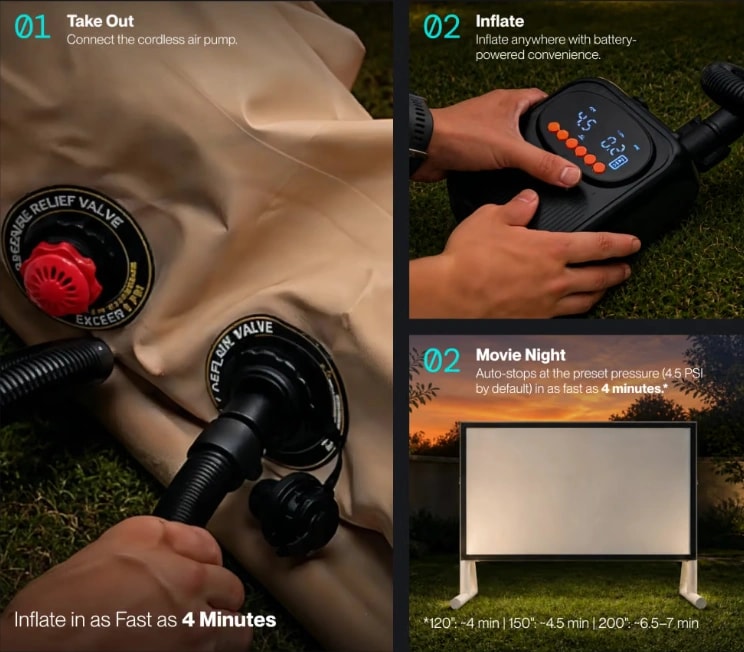
Pumping air into the frame is only one part of the setup. Complete installation includes attaching the viewing fabric, tensioning the corners, anchoring the structure, and aligning your projected image with the screen borders.
A reinforced T-frame design simplifies this workflow by reducing the number of support lines needed to keep the screen upright, allowing the entire setup to take roughly 10 minutes. However, a faster frame design never replaces proper anchoring. Setting up a T-frame inflatable projector screen involves three straightforward steps that takes 5-10 minutes:
- Inflate the frame and seal the valve: Use the electric pump or blower to inflate the frame to the recommended pressure, then turn off the inflator and tightly close the valve cap.
- Attach the viewing surface with tension hooks: Clip the projection screen to the frame and secure all tensioning hooks evenly so the viewing surface pulls flat.
- Raise the frame and secure with sandbags or waterbags: Stand the T-frame upright and anchor the base and guy lines using ground stakes, sandbags, or water-weight bags.
Check What the Viewing Surface Is Made Of
A high-quality, wrinkle-resistant inflatable projector screen is typically crafted from durable polyester fabric with a bright matte-white viewing surface and a black backing that blocks light penetration. While folding the fabric between movie nights can leave temporary storage creases, proper corner tensioning pulls minor wrinkles smooth. Deep creases can warp the image geometry or cast visible shadows across the picture until tension pulls them flat.
Keep your hands and the ground area clean when clipping the viewing surface onto the frame. Before setting up, verify whether your specific screen supports front projection only or both front and rear projection, and always follow the care label, never assume every detachable screen fabric is machine-washable.
Check Packed Size and Handling
Before buying, and when packing down after an event for once, check the screen's deflated dimensions, total weight, included storage bag, and whether assembly requires one or two people. A screen that packs neatly into a compact carry bag makes occasional backyard movie nights and garage storage far more practical.
Inflatable vs. Folding Projector Screens: Which Fits Your Routine?
If you are torn between an outdoor inflatable movie screen and a portable folding-frame screen, compare how each design fits your storage space and hosting habits:
|
Consideration |
Inflatable Screen |
Folding-Frame Screen |
|
Setup Process |
Requires inflation, surface attachment, support and anchoring |
Requires frame assembly, surface attachment, legs and anchoring requirements |
|
Power during viewing |
Depends on continuous-airflow or sealed-air design |
The frame itself does not require inflation power |
|
Handling and Storage |
Depends on the folded structure, pump, accessories, and packed dimensions |
Depends on frame sections, legs, screen fabric, and carrying dimensions |
|
Choosing between them |
Evaluate based on the complete setup process and available space |
Evaluate based on the complete setup process and available space |
Our Take: Always choose around the setup routine, yard size, and storage constraints you can comfortably manage on movie night.
What to Check Before Buying a Backyard Screen
- Is the advertised measurement the diagonal picture size or the overall frame dimensions?
- Does the complete footprint, including throw distance, seating, and tether lines, fit your yard?
- Does a blower have to run continuously during the movie, or is it a sealed-air design?
- What inflation and anchoring accessories (pump, stakes, guy lines, waterbags) are included in the box?
- What equipment (projector, speakers, cables, power station) must be purchased separately?
- What does the manual specify regarding wind limits, fabric cleaning, and dry storage?
Quick Outdoor Screen Use Guidance
For the sharper contrast and more accurate colors, schedule your screening after sunset in low ambient light. Always follow your screen’s operating manual, protect powered electronics from evening dew or moisture, and make sure to tightly close the valve cap on a sealed-air frame after inflation.
Standard sealed-air inflatable screen models that require periodic top-ups, the AWOL Valerion Inflatable Outdoor Movie Screen stays inflated for up to 72 hours. If an inflatable setup still feels too large for your space, there are various screens other than blow up projector screens that might be a good fit for you.
Inflatable Projector Screen FAQs
Does an Inflatable Movie Screen Come With a Projector?
It depends on the package you select. Standard screen listings include the screen and inflation kit only, unless you select a complete projector-and-screen bundle. Always check the "What's in the Box" section before ordering.
Does an Inflatable Projector Screen Come With a Blower?
Yes, most models include either a continuous electric air blower or a high-pressure electric air pump for inflation. However, included accessories vary by brand and model, so verify the package contents prior to checkout.
Can You Turn the Blower Off During the Movie?
Only if you buy a sealed-air model. Continuous-airflow screens collapse as soon as the blower loses power, whereas screens like the AWOL Valerion Inflatable Outdoor Movie Screen—lock air inside the frame so you can turn off and unplug the pump before the movie starts.
Can You Use an Inflatable Screen in Daylight?
No outdoor screen can fully overcome direct sunlight. Even with a high-lumen projector, daytime ambient light washes out contrast and black levels. For a vivid, cinema-quality picture, start your screening at dusk or after full dark with minimal surrounding light.
Is an Inflatable Projector Screen Easy to Transport and Store?
Yes. Once deflated, the frame and detachable viewing surface fold down into an included carrying bag, making the screen easy to store in a closet or transport in a car trunk between movie nights.
How Do I Clean and Maintain an Inflatable Projector Screen?
Spot-clean the viewing fabric according to the care instructions using a soft microfiber cloth, mild soap, and cool water. Always let both the screen fabric and the inflatable frame dry completely before folding and packing them away to prevent mildew.
Can an Inflatable Projector Screen Be Used in Windy Conditions?
An inflatable screen can be used outdoors in calm to mild breezes when properly anchored with stakes, guy lines, and sandbags or waterbags. Strong winds or gusty weather can make any large outdoor screen unsafe, so always follow the manufacturer's wind limits and take the screen down if winds pick up.
How Do I Choose Between Front and Rear Projection?
Front projection places the projector in front of the screen on the audience's side, delivering maximum brightness and the simplest setup. Rear projection places the projector behind a translucent, rear-compatible screen, which keeps cords and equipment completely out of the seating area, provided you have enough open yard space behind the frame.
Exclusive Welcome Benefit
Unlock Your AWOL Valerion Cinema Experience
Subscribe to unlock your game day guide and early access to seasonal deals

Points & Rewards

Member Pricing

Priority Support

Early Access
New subscribers receive a $100 discount code by email.
Discover More Insights