How a Laser Projector Works: The Technology Explained in Plain English
October 16, 2026
Every projector does the same three jobs: make light, turn that light into a picture, and throw the picture onto a screen. What separates a laser projector from the lamp projectors of the last two decades is the first job — and that single change ripples through everything else. It is why laser machines show colours lamp projectors physically cannot, why they switch on instantly, and why their brightness holds for a decade and a half instead of dimming within a season.
It is also why they have one quirk lamp projectors never had: speckle, a faint shimmer some viewers notice on bright patches of the picture.
Here is the whole journey of the light, from diode to screen, in the order it actually happens.
What's Happening Inside a Laser Projector
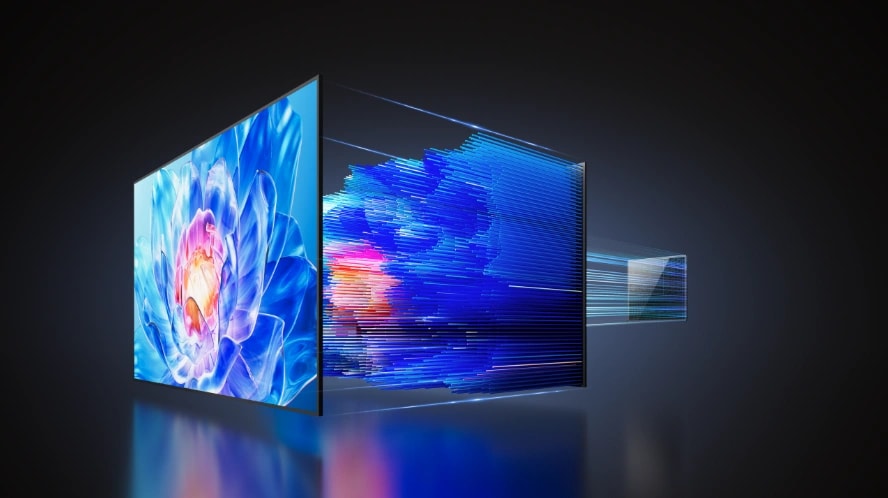
Start with the contrast that explains everything. A lamp projector makes light the way a bonfire does: burn something — in this case, an ultra-high-pressure mercury arc — and you get a broad splash of white light in every direction. That light then has to be collected, filtered into red, green and blue, and anything that is the wrong colour is thrown away.
A laser projector makes light the way a laser pointer does: run current through a semiconductor diode and it emits a tight, concentrated beam at one very precise wavelength. The light is already the colour you want, already travelling in the direction you need, and available the instant you switch on. Nothing is filtered out, because nothing was made that you did not want.
Once the light exists, the rest of the machine is familiar: the coloured beams are combined, an imaging chip turns them into a picture, and a lens throws that picture onto your screen at whatever size the room allows. Our flagship, the AWOL Valerion Max, is a useful example to carry through this guide, because it uses the most demanding version of each stage — discrete red, green and blue lasers, a 4K imaging chip, and a motorised lens — and its spec sheet maps one-to-one onto the concepts below.
The interesting parts are the two stages in the middle: how lasers make colour, and how a chip makes a picture out of it.
How a Laser Projector Makes Colour (and Why It's So Good at It)
Not every laser projector makes colour the same way. There are two main routes, and which one a projector uses tells you a lot about its price and its picture.
Single-Laser: Blue Light Plus Phosphor
The affordable route starts with a single blue laser and a spinning wheel coated in yellow phosphor — the same glowing material inside old fluorescent tubes. Blue laser light hits the phosphor, the phosphor glows yellow, and dichroic filters then split that yellow into red and green. A portion of the original blue passes straight through a clear segment of the wheel. Red, green, blue: the three primaries, from one laser.
It is a clever, cost-effective design, and it powers most entry-level laser projectors. The compromise is colour purity. The light that comes off a phosphor is a spread of wavelengths, not a single line — closer to lamp light than to true laser light — so the colour gamut, while better than a lamp's, stops short of what lasers can do.
Triple-Laser: Discrete Red, Green and Blue
The other route skips the phosphor entirely. Three sets of laser diodes — red, green and blue — each emit their own primary colour directly. What goes into the optical path is what comes out of the lens. This is the design cinema projectors use, and it is what "RGB triple laser" on a spec sheet means. The AWOL Valerion Max, for instance, uses discrete RGB lasers and covers 110% of the Rec. 2020 colour space, which is a way of saying it can produce every colour the ultra-wide cinema standard defines, with room to spare.
Why Narrow Light Means Wide Colour
This is the piece most explanations skip, and it is genuinely worth two minutes.
The colour of light is a matter of wavelength. Sunlight, lamps and phosphors all emit a broad mix of wavelengths at once — that is why a "white" lamp looks white. A laser, by contrast, emits an extremely narrow band: almost pure single-wavelength light. Engineers call this narrow-band light; you can think of it as a purer ingredient.
Colour mixing works like a triangle. Take your purest red, your purest green and your purest blue, and every colour you can make sits inside the triangle those three corners define. Purify the corners and the triangle grows. Because laser primaries are nearly single-wavelength, a triple-laser projector's triangle stretches out to the edges of human vision — which is precisely what the Rec. 2020 standard describes. Lamp and phosphor light, with their mushier primaries, can only manage a smaller triangle, roughly the older DCI-P3 standard at best.
That is the honest physics behind the marketing line "laser colour". It is not a software trick; it is what narrow-band light makes possible. If you want to go deeper on how displays define white and colour accuracy, our colour temperature guide covers the calibration side.
From Light to Picture: The Imaging Chip
Coloured light is still just light. Something has to draw the picture with it, and that is the imaging chip — the component the "4K" or "1080p" on the box refers to. Three technologies do this job, and lasers can drive any of them.
DLP is the most common in laser home projectors. At its heart is a chip called a DMD — a mirror array with around two million tiny hinges, one per pixel on a 1080p chip. Each mirror tilts either toward the lens (pixel lit) or away from it (pixel dark), and flips fast enough to build shades of grey by spending more or less of each frame in the "on" position. The AWOL Valerion Max uses a Texas Instruments 0.47-inch DMD, and reaches 4K UHD through XPR pixel shifting: four times per frame, the image is nudged half a pixel diagonally, so the chip's mirrors address all 8.3 million pixels of a 3840×2160 picture in rapid succession. Your eye integrates the sequence into one sharp 4K image.
3LCD uses three separate transmissive LCD panels, one for each primary colour. The projector separates the light into red, green and blue channels, modulates each channel with its own panel, and recombines them into a full-colour image. Like an LCD television, it relies on light passing through a liquid-crystal layer rather than on the liquid crystals emitting light themselves. LCoS is a reflective variant used in some high-end home cinema machines, prized for contrast.
One honest footnote belongs here, because it affects a real minority of viewers. A single-chip DLP projector shows red, green and blue in fast succession rather than all at once, and some people's eyes catch the seams — brief colour fringes on high-contrast edges, known as the rainbow effect. Triple-laser engines help, and the AWOL Valerion Max adds dedicated anti-rainbow-effect processing that reviewers have found effective — but the underlying physics of sequential colour cannot be abolished, only pushed past the threshold of perception. If you know you are rainbow-sensitive, demo any single-chip DLP projector before buying it, whatever its light source.
Lens and Screen: Where Speckle Comes From
The last stages are the ones you can actually touch. The lens takes the chip's tiny image and throws it across the room — and the quality of its glass decides whether the corners of your picture stay as sharp as the centre. Zoom sets how far the projector can sit from the screen (the AWOL Valerion Max's 0.9–1.5:1 throw ratio covers a 120-inch picture from roughly 2.4 to 4 metres), and lens shift moves the image optically, without tilting the machine and warping the geometry (±105% vertical on the AWOL Valerion Max — an unusually wide range that simplifies shelf and ceiling placement no end).
Then the light hits the screen, and for triple-laser projectors this is where the one genuinely laser-specific phenomenon appears.
Laser light is coherent: the waves march in step, crest aligned with crest. When coherent light reflects off a surface that is even slightly rough — and every screen and painted wall is rough at the scale of a light wave — the scattered waves interfere with one another, some reinforcing and some cancelling. The result is a fixed, grainy pattern of brighter and darker specks over the image: laser speckle. It reads as a subtle shimmer that shifts as you move your head. Lamp light and phosphor light are incoherent — their waves are a disorderly crowd, not a march — which is why only laser projectors show it, and why RGB triple-laser machines, with the purest light of all, show it most.
Speckle is managed, not abolished. On the projector side, the optical engine despeckles — deliberately introducing controlled variation into the beam so the interference pattern averages out; on the screen side, materials are engineered to break up the surface pattern further. The AWOL Valerion Max applies speckle reduction in the engine, and pairing it with a screen designed for the job, like our PureVision anti-speckle material, completes the treatment. In a normal viewing setup, what remains is at the threshold of visibility for most people. But if a shop demo looks slightly grainy on bright white scenes, now you know what you are seeing — and that it is a property of the technology, not a faulty unit.
Why Laser Beats Lamp: Lifespan, Brightness, Instant On
The practical case for laser comes down to three numbers-backed behaviours.
Lifespan. A mercury lamp is rated for roughly 3,000–5,000 hours, after which you buy and fit a replacement. Laser light sources are rated for 20,000–30,000 hours. The AWOL Valerion Max is rated at 25,000: at four hours of viewing a day, every day, that is seventeen years before the light source reaches half brightness — for most homes, longer than the projector's other components will stay in service.
Stability. Lamps do not fail so much as fade: a meaningful share of their brightness is gone within the first few hundred hours, and the picture you calibrate in month one is not the picture you get in month twelve. Laser output holds its level across the years, which is also why colour stays put — the calibration you set stays true because the light feeding it does not change.
Instant on. Lamps need a warm-up to reach full brightness and a cool-down before you can move the machine. Lasers are at full output the moment you press the button and can be switched straight off. It sounds trivial until your projector stops behaving like a ceremony and starts behaving like a television.
|
Lamp |
LED |
Laser |
|
|
Typical light-source life |
3,000–5,000 hrs |
20,000–30,000 hrs |
20,000–30,000 hrs |
|
Peak brightness |
Moderate |
Low to moderate |
High |
|
Colour gamut |
Narrow (DCI-P3 at best) |
Good |
Widest (Rec. 2020 with RGB) |
|
Warm-up / cool-down |
Yes / yes |
No / no |
No / no |
|
Brightness over time |
Fades noticeably |
Stable |
Stable |
|
Upfront cost |
Lowest |
Low to mid |
Highest |
Brightness itself deserves its own conversation — how many lumens your room actually needs depends on screen size, ambient light and screen material, and our projector lumens guide works through that properly.
The Honest Downsides of a Laser Projector
We build these machines, and we would still rather you knew the trade-offs before the receipt.
Price. Laser light engines cost more to build than lamps, full stop. Expect the laser premium at every tier; premium triple-laser machines sit in the low thousands. The running-cost maths favours laser over a decade — no replacement lamps, stable brightness — but the entry ticket is real.
Speckle. As above: an RGB-laser reality, managed but not eliminated. Demo bright scenes before buying if you are picky.
Rainbow effect on single-chip DLP models. Not laser-specific, but most laser home projectors are single-chip DLP, so it belongs on the list. Sensitive viewers should check.
No user-replaceable light source. A lamp owner can swap a dead bulb in ten minutes; a laser module is sealed and a failure means a service visit. The 25,000-hour rating makes this unlikely to matter within the machine's useful life — but it is a genuine difference in how you own the product.
None of these are secrets or defects. They are the known terms of the technology, and every one of them is knowable before you spend anything.
Is a Laser Projector as Good as a TV?
Honest answer: for some rooms, yes and then some; for others, no — and the deciding factor is light you cannot control.
A television is a light source fighting your room's light, and it is very good at that fight. On a bright Saturday afternoon with the blinds open, a TV wins, full stop. A projector — any projector — works with reflected light, and reflected light loses to daylight. What laser has done is close the gap at the edges: with 3,500 ISO lumens and an ambient-light-rejecting screen, an evening film in a normally lit living room is entirely watchable in a way lamp-era projectors could not manage, and laser brightness holds that line for years.
Where the room can be dimmed, the comparison flips entirely. A 100-inch-plus picture for less per inch than a large television, with cinema colour and scale no panel matches — that is the projector's home ground, and it is why people build dedicated home cinema setups around them.
So: daytime, uncontrolled light, one glance at the screen while doing other things — television. Evening films, sport, gaming, anything where the room yields — a laser projector, comfortably.
Frequently Asked Questions
What are the downsides of a laser projector?
Four, honestly: a higher upfront price than lamp equivalents; speckle, a faint shimmer unique to laser light, managed but not eliminated on RGB models; possible rainbow effect on single-chip DLP machines if you are among the sensitive minority; and a sealed light source that cannot be user-replaced if it fails. All four are knowable, and checkable, before purchase.
Are laser projectors any good?
For home cinema, yes — they are the current best answer. Wider colour than lamp machines can produce, stable brightness for 20,000–30,000 hours, instant on, and high output that copes with real living rooms. Evaluate your room's light first; the technology deserves better than a sunlit white wall.
How long will a laser projector last?
The light source is typically rated for 20,000–30,000 hours — the AWOL Valerion Max at 25,000, which is around seventeen years at four hours a day. "Last" here means reaching roughly half brightness, not dying; output stays stable along the way. The rest of the machine's lifespan depends on its other components, as with any electronics.
Is a laser projector as good as a TV?
In controllable light, better — bigger picture, cinema colour, less eye strain from reflected rather than emitted light. In uncontrollable daylight, worse; nothing reflected beats a panel in direct sun. Laser has narrowed that gap sharply on brightness and lifespan, which is why the choice now comes down to your room, not the technology.
Discover More Insights