Are you getting noise complaints from neighbors, or trying to avoid waking your family during heavy bass drops? You have invested significantly to create a cinematic experience at home, but that investment loses value if you cannot turn up the volume. It feels like you are limiting your own potential, like your car is a race car and you are stuck driving under 20 mph.
To get the most from your investment, you need to contain sound in your room and stop outdoor noise leaking in. By understanding how to soundproof a home theater and implementing proper techniques, you can enjoy true 3D sound without limitation. This guide covers everything from the basic principles of home theater soundproofing and room materials to step-by-step implementation.
What is Home Theater Soundproofing and Why Does It Matter?
When you experience true cinematic sound at home, the audio travels through walls and other surfaces in the form of waves. True soundproofing focuses on creating a physical barrier to reduce sound transmission and prevent noise from escaping or entering a room.
When planning and building a home cinema, you must treat two distinct types of sound: airborne noise (such as movie dialogue) and structure-borne noise (such as subwoofer vibrations shaking the house frame).
Soundproofing vs. Acoustic Treatment: Understanding the Difference
Before selecting sound proof room materials, you must understand the difference between soundproofing and acoustic treatment. Soundproofing keeps noise inside the room and stops outdoor noise from leaking in. Acoustic treatment improves the audio quality inside the room by reducing echoes and reverberations.
Why Acoustic Foam Cannot Soundproof Your Theater Room
Audio from a sound system travels in waves across high, mid, and low frequencies. Most standard walls provide some resistance to sound transmission, but low-frequency bass requires significantly more mass and structural isolation.
Standard acoustic foam lacks the mass and density required to block low-frequency bass. While acoustic foam helps you hear audio more clearly inside the room, it has very little transmission loss and will not stop your neighbors from hearing your movie. To block those frequencies, true home theater soundproofing is required.
The Four Principles of Effective Home Theater Soundproofing
Effective home theater soundproofing relies on four proven principles. By combining these methods, you establish a comprehensive sound barrier.
Adding Mass To Block Sound Frequencies
Adding mass with dense sound proofing materials helps block sound from leaking into adjacent rooms. While adding heavy furniture to a room can slightly reduce sound reflections, it does not significantly soundproof walls. For better isolation, add an extra layer of drywall. Mass Loaded Vinyl (MLV) also improves airborne sound isolation when correctly installed as part of a complete wall assembly.
Decouple Structures to Reduce Vibration Transfer
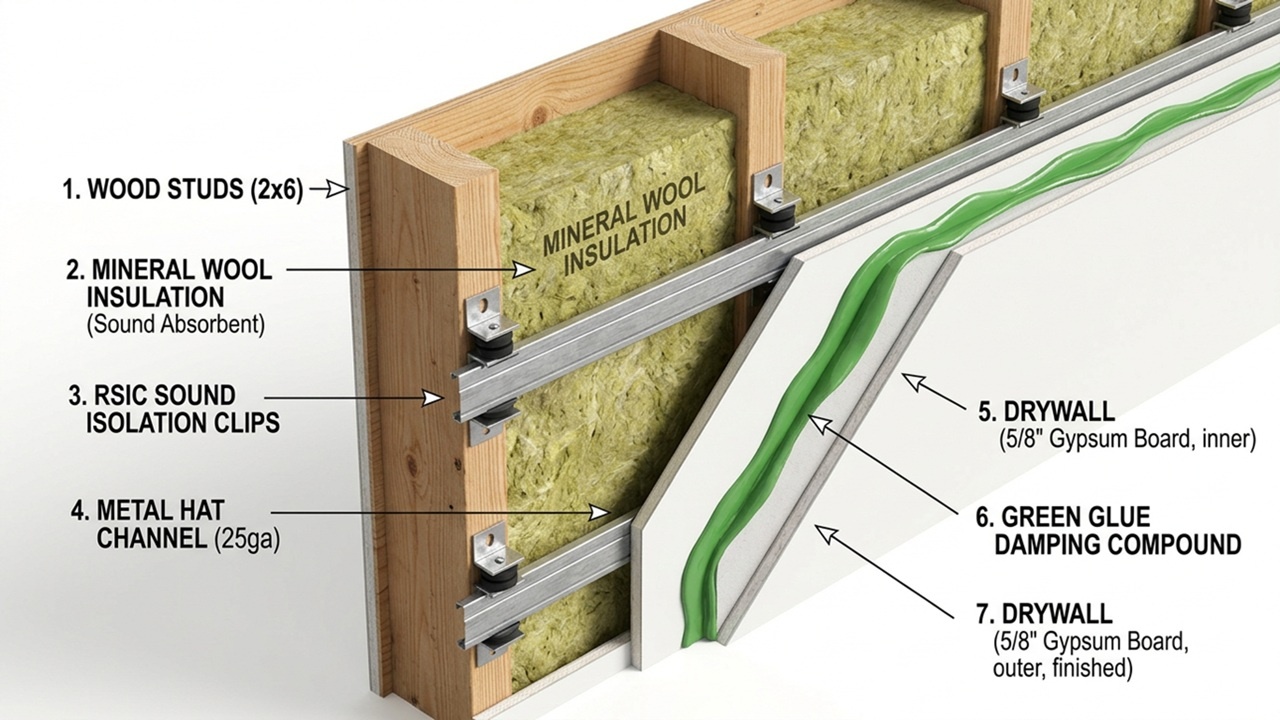
One of the easiest ways for sound to travel into another room is directly through the building's framing. Decoupling breaks the physical connection between the room's drywall and the structural framing. By using floating walls, floating ceilings, or resilient sound isolation clips, you prevent bass vibrations from traveling through the wood studs.
Use Damping Materials to Absorb Sound
The next essential principle is damping. Damping compounds, such as Green Glue, are applied between layers of drywall. These specialized compounds dampen sound vibrations by converting kinetic sound energy into trace amounts of heat, reducing vibration transfer between rigid layers.
Seal Air Gaps to Prevent Leakage
Many homeowners invest in decoupled structures but forget to seal air gaps, leaving sound highly audible in other rooms. Sound acts like water: if air can get through a crack, sound will too. Seal as many air gaps as possible because even small openings allow sound to escape. Always use acoustic sealant around door frames, outlets, and baseboards.
Best Soundproof Materials That Actually Work
The key to a successful project is choosing the correct sound proof room materials. For the best results, pair materials that block sound with materials that dampen and absorb sound.
Materials that Block Sound
- Standard Drywall: It’s an affordable way to add mass. Its effectiveness depends heavily on the thickness of the panels and the overall STC (Sound Transmission Class) rating of the wall assembly. Decent thickness can usually block normal speech-level noise.
- Mass Loaded Vinyl (MLV): It is a dense and flexible material that is highly effective at blocking airborne sound when installed properly within a wall or ceiling cavity.
- Green Glue: It is an industry-standard damping compound used between layers of drywall or flooring to reduce vibration transfer.
- Resilient Sound Isolation Clips (RSIC): These are mechanical clips placed between studs and drywall channels to decouple the structure and stop vibration pathways.
Materials that Absorb Sound (For Internal Cavities)
- Mineral Wool / Fiberglass Insulation: It’s used to loosely fill wall and ceiling cavities to absorb trapped sound resonance. Fiberglass can irritate the skin and lungs during installation, so always wear appropriate protective equipment (PPE).
- Acoustic Panels: They are used purely for internal acoustic treatment to stop echoes caused by reflection. They do not prevent sound from leaving the room.
How to Choose Soundproofing Materials
| Material | Best for |
|---|---|
| Mass Loaded Vinyl | Adding mass without rebuilding walls |
| Green Glue | Reducing vibration between drywall layers |
| Mineral Wool | Wall cavity insulation |
| Acoustic Panels | Improving internal clarity |
Step-by-Step: How to Soundproof a Home Theater
You do not always need a professional to soundproof your cinema room. Here are the actionable steps to effectively isolate your space.
Step 1: Soundproof the Walls
When constructing your room, fill the empty wall cavities with mineral wool or fiberglass insulation. For an existing room or an easy upgrade, add a second layer of drywall with Green Glue sandwiched in between. To achieve maximum isolation, mount the new drywall onto decoupling clips and metal channels attached to the studs.
Step 2: Upgrade Doors
Hollow-core doors are the weakest link in any room because they lack the mass to block sound frequencies. Replace hollow doors with solid-core wood or heavy metal doors. Additionally, install an automatic door bottom and perimeter weatherstripping to seal the air gaps between the door and the frame.
Step 3: Isolate Floors and Ceilings
Now that you understand the principles of how to soundproof a home theater, a major factor is addressing structure-borne sound. Use acoustic rubber underlayment beneath thick carpets. Place your subwoofer on a dedicated isolation pad to reduce the mechanical vibration transfer into the floor (though keep in mind this will not stop airborne bass from traveling).
Avoid recessed lighting in your ceiling. Penetrations for recessed lights compromise your sound barrier and allow noise to escape into the floor above and transfer potential vibrations into house structure. Instead, utilize suspended track lighting, surface-mounted fixtures, or LED strips.
Step 4: Treat Windows
Sound easily travels through the thin glass of standard windows. While acoustic curtains provide a modest reduction in sound reflection, they do not block heavy noise. For true soundproofing, install heavy DIY window plugs, acoustic window inserts, or secondary glazed interior windows.
How Much Does it Cost to Soundproof a Home Theater?
The cost of soundproofing a home theater can range from a few hundred dollars for basic improvements to more than $10,000 for a professionally designed cinema room. The final price depends on several factors, including room size, existing construction, the level of sound isolation required, and whether you handle the work yourself or hire a contractor.
Basic DIY Soundproofing: $500–$1,500
For homeowners looking to reduce everyday noise without major remodeling, basic soundproofing improvements usually cost between $500 and $1,500.
This budget typically covers simple upgrades such as sealing gaps around doors and walls with acoustic caulk, replacing hollow-core doors with heavier solid-core doors, adding thick rugs or carpeting, and placing isolation pads under subwoofers to reduce vibration transfer.
These improvements can noticeably reduce sound leakage, but they will not completely block powerful bass frequencies or achieve professional theater-level isolation.
Moderate Soundproofing Upgrades: $2,000–$5,000
A more effective home theater soundproofing project usually involves modifying the room structure and adding dedicated soundproofing materials.
A budget of around $2,000 to $5,000 may include adding an additional drywall layer with Green Glue damping compound, installing acoustic insulation inside wall cavities, and using basic resilient clips to reduce vibration transfer.
This approach provides a significant improvement over basic fixes, especially for homeowners converting existing rooms into dedicated theaters.
Professional Home Theater Soundproofing: $10,000+
A fully isolated home theater designed for maximum sound control can cost $10,000 or more.
Professional installations may include room-within-a-room construction, complete structural decoupling, heavy Mass Loaded Vinyl (MLV), specialized HVAC acoustic treatment, and extensive sealing of potential sound leakage points.
This level of soundproofing is typically chosen for dedicated cinema rooms where homeowners want powerful surround sound and subwoofer performance without disturbing the rest of the house.
Managing Projector Noise in a Soundproofed Room
Once a room is successfully soundproofed and sealed, the ambient noise floor drops dramatically. In a dead-quiet room, your projector’s standard cooling fan noise becomes a distraction during important quiet and intense movie scenes. Wall soundproofing stops noise from leaving the room, but it does not remove noise generated inside.
To fix this issue, you can build a ventilated acoustic hush box around your projector to contain the fan noise. Alternatively, to save the hassle, invest in premium projectors engineered for silent operation. For example, modern projectors like the AWOL Valerion projectors combine advanced RGB triple-laser light sources with highly efficient, ultra-quiet cooling fans, often running around a low 28 dB rating.
Frequently Asked Questions
Can I soundproof a room from noisy neighbors?
Yes. Improving wall insulation, sealing air gaps, adding mass to shared walls with extra drywall, and installing window inserts can significantly reduce noise entering from neighboring rooms or outside traffic.
Can I soundproof a room without removing existing drywall?
Yes. You can add a damping compound like Green Glue and a second layer of drywall directly over your existing wall. While this significantly reduces airborne noise, it will not stop heavy structure-borne bass as effectively as full structural decoupling.
What is the cheapest way to soundproof a room?
The most affordable options focus on sealing gaps. Use acoustic caulk on baseboards, apply weatherstripping to doors, install heavy solid-core doors, and place isolation pads under speakers.
How do I stop the subwoofer bass from traveling through my house?
Low-frequency bass is the hardest sound to stop. Use a subwoofer isolation pad to break direct mechanical contact with the floor, and invest in decoupling techniques (resilient channels and clips) for the room's drywall.
Does adding furniture help with soundproofing?
Large, dense furniture can absorb internal reflections and improve room acoustics, but it does not add enough structural mass to the walls to prevent sound from leaving the room.
Do acoustic panels help with soundproofing?
No. Acoustic panels only improve the sound quality inside the room by reducing echo and reverberation. They do not have the mass required to stop sound transmission.
Which materials are best for soundproofing walls?
The best approach relies on a combination of sound proof room materials. A highly effective wall assembly typically includes mineral wool cavity insulation, resilient sound isolation clips (RSIC), hat channels, and two layers of heavy drywall separated by Green Glue damping compound.
How do I reduce footsteps from upstairs?
Installing acoustic ceiling insulation, utilizing resilient ceiling decoupling systems, or adding thick acoustic underlayment and carpeting to the floor upstairs will significantly reduce impact noise.