Surround Sound Speaker Placement: The Ultimate Guide to a Perfect Home Cinema Setup
August 14, 2026
Proper surround sound speaker placement is the single biggest factor in creating an immersive home theater. Whether you are setting up a 5.1, 7.1, or Dolby Atmos system, correct speaker positioning dramatically improves dialogue clarity, surround effects, and overall realism. A well-planned home theater layout bridges the gap between basic flat audio and truly immersive surround sound.
This guide breaks down the best home cinema speaker placement for your room layout, ensuring you achieve reference-level surround imaging without struggling to figure out where to place bulky speakers, whether you're in a small apartment or a dedicated theater room.
Understanding Surround Sound Speaker Layouts: 5.1, 7.1, and Dolby Atmos Explained
Home theater audio has evolved significantly over the decades. It progressed from basic Stereo to Dolby Surround and Pro Logic, then to 5.1 and 7.1 channel formats, and finally to object-based audio formats like Dolby Atmos.
- 5.1 Speaker Placement: Uses six speakers: front left and right, center, surround left and right, and one subwoofer. This forms the traditional ear-level layout (often called the "bed layer").
- 7.1 Speaker Placement: Expands on the 5.1 speaker placement foundation by adding two dedicated rear surround speakers for a full 360-degree panning experience.
- Dolby Atmos Speaker Placement: Adds an overhead "height" dimension (using ceiling-mounted Atmos height speakers, in-ceiling speakers, or up-firing modules) to the traditional ear-level speakers.
While theatrical Atmos can support up to 128 simultaneous audio tracks, including up to 118 dynamic audio objects plus bed channels, consumer AV receivers adapt Dolby Atmos rendering to the available speaker configuration (such as 5.1.2 or 7.1.4). The primary difference between 5.1.2 and 4.1.2 layouts is the addition of a dedicated center channel in the 5.1.2 configuration for crisp and distinct dialogue.
Best Position for Surround Speakers
The best position for surround speakers depends on maintaining proper surround speaker angles relative to your reference listening position. Following the International Telecommunication Union (ITU-R BS.775) standard and proper Dolby speaker layout guidelines ensures your setup delivers accurate surround imaging.
What is the Best 5.1 Speaker Placement?
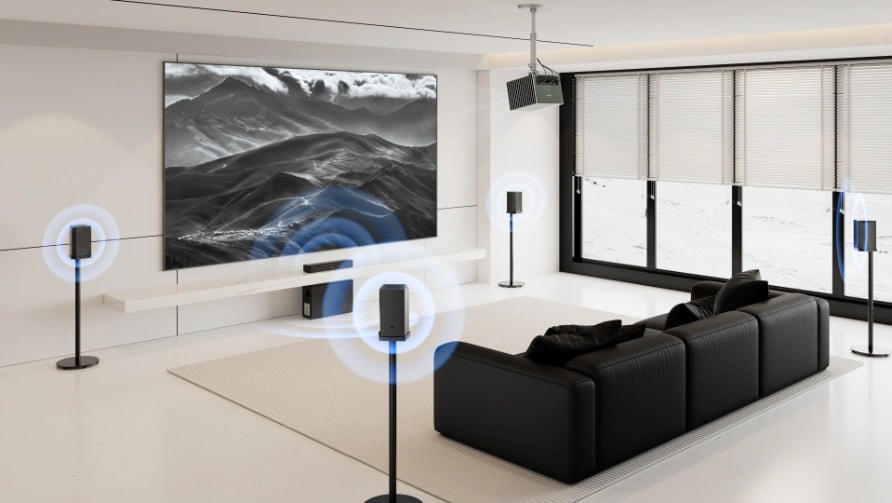
For the best 5.1 surround speaker placement, your front left and right speakers should be placed at ±30° relative to the center of the screen. This positions the listener at the third point of an equilateral triangle formed by the front speakers. Do not forget a slight speaker toe-in, aiming the tweeters directly at the main listening area. The left and right surround speakers should be placed at 90° to 110° to your sides, facing directly toward the seating area.
What is the Best 7.1 Speaker Placement?
A 7.1 setup keeps the front and side surround speakers exactly where they are in a 5.1 layout but adds two rear surround speakers to handle rear-hemisphere action. Focus on the angles rather than just physical speaker distance: place the rear surrounds at 135° to 150° behind the listening position to maximize surround imaging.
What is the Best Dolby Atmos Speaker Placement?
Dolby Atmos requires physical separation between ear-level speakers and height channels. For overhead speakers, they should ideally be mounted in or on the ceiling. Elevation angles depend on your specific configuration, whether you are using Top Front, Top Middle, Top Rear, or Dolby Enabled up-firing speakers.
For example, in a standard 5.1.2 setup, the two Top Middle speakers should be placed slightly forward or directly above the listening position at an elevation angle of 65° to 100°. For setups with four height channels (like 5.1.4), you will utilize Top Front (typically 30° to 45°) and Top Rear (typically 135° to 150°) positions to create a complete overhead dome.Always note that exact angles vary depending on your specific Atmos configuration. Once your horizontal layout is locked in, the next crucial step is determining the proper elevation for your setup.
Best Speaker Height for Surround Sound
The ideal elevation for your base-layer speakers (front, center, and side surrounds) is directly aligned with your seated ear height. Specifically, the tweeters should align with the listener's ears when seated on the couch. What about DTS? How does DTS surround sound encoding differ from the Atmos? While DTS:X uses object-based audio similar to Dolby Atmos and is compatible with the exact same physical speaker layouts, its rendering technology differs slightly.
While strict Dolby Atmos guidelines recommend exact ear level for the base layer to maximize spatial separation from the height channels, many home theater installations mount surround speakers slightly above ear level (about 1 to 2 feet). This prevents the sound from blasting directly into the nearest listener's ear while maintaining a balanced surround field across multiple seats.
Home Cinema Speaker Placement for Large Projector Screens
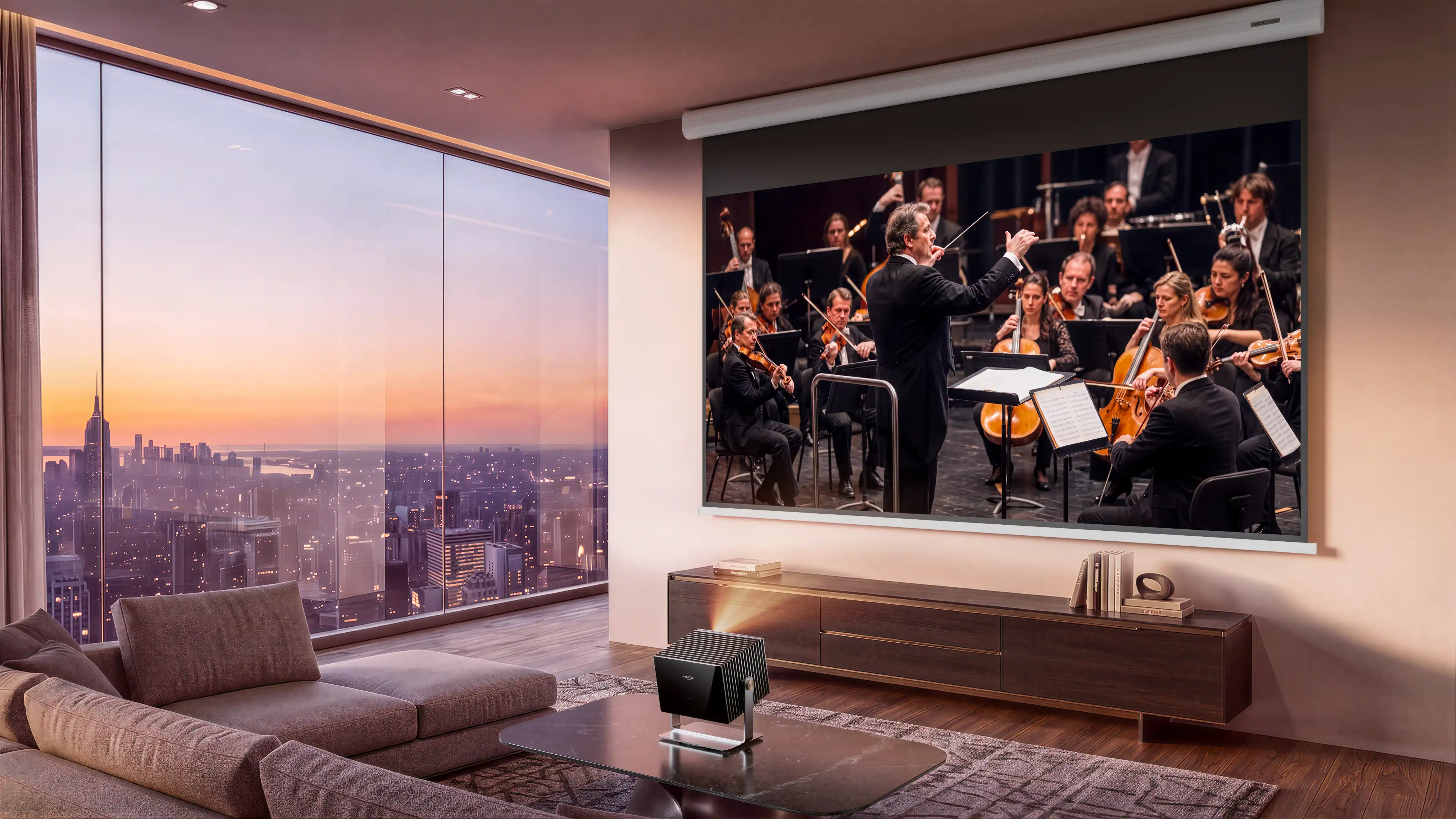
Premium home theater projectors project a larger screen that delivers a fully immersive experience. If you have a projection screen larger than 100 inches, you require a unique visual and acoustic relationship. For a screen this large, standard speaker placement rules must be stretched. Pushing the left and right speakers further apart to clear the screen can compromise your acoustic triangle, and massive screens often force the center speaker too close to the floor.
For the ideal home cinema speaker placement with large displays, place the center speaker carefully aligned below or directly above the screen, and angle it slightly toward ear level. If you want the ultimate theater experience, invest in an Acoustically Transparent (AT) screen. AT screens are made of woven acoustic materials that allow you to place the center speaker directly behind the screen, making dialogue appear to come directly from the screen itself.
Where to Put Surround Speakers in a Small Room
Figuring out where to put surround speakers in a small room can be tricky, especially when your couch is pushed flush against the back wall.
- Use Bipole/Dipole Speakers: These provide a diffused sound field, which is highly beneficial when speakers are right next to the listener.
- Optimize Surround Speaker Mounting: Elevate the side surrounds slightly and angle them down toward the listening position if mounted directly on the side or back walls.
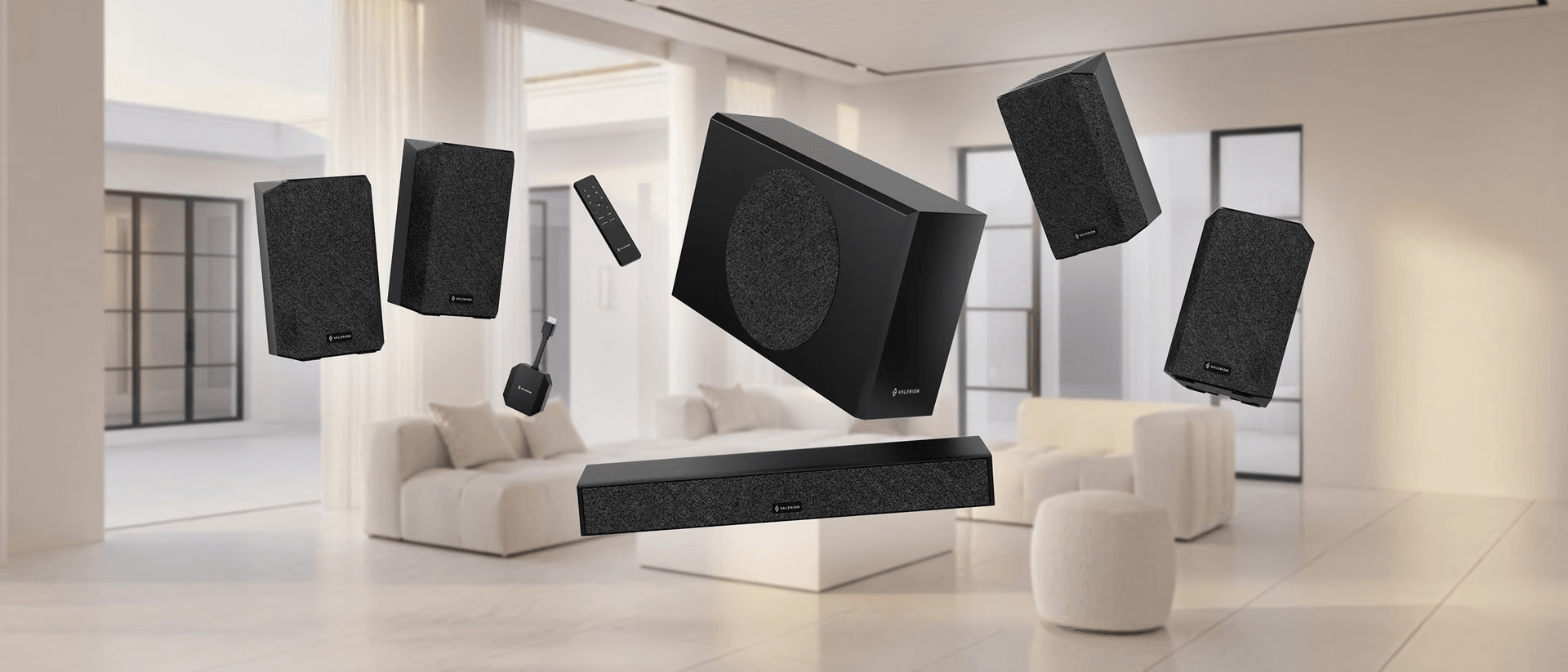
- Go Wireless: Cable management is tough in tight spaces. Consider compact or wireless rear audio solutions, such as the AWOL Valerion Thunderbeat, to avoid running long cables across a small apartment.
Common Surround Sound Placement Mistakes (And How to Fix Them)
Avoid these frequent errors to ensure perfect audio playback:
- Mistake: Placing front ear-level speakers too high up near the ceiling.
- Fix: Adjust speaker height to ear level.
- Mistake: Putting the center channel too low without angling it upward.
- Fix: Angle the center channel speaker upwards to your main seating position.
- Mistake: Placing the subwoofer where it "looks best" without testing for optimal acoustic response. It creates uneven bass.
- Fix: Use the subwoofer crawl method to find the best placement for a subwoofer.
- Mistake: Placing side surround speakers directly behind the couch instead of at the sides in a 5.1 setup.
- Fix: Move them to the left and right of the main listening position at a 90° to 110° angle.
- Mistake: Tucking speakers tightly into corners or pushing them flush against walls. Placing speakers too close to hard boundaries can sometimes cause Speaker Boundary Interference Response (SBIR), which cancels out bass frequencies.
- Fix: Pull speakers slightly away from the wall to mitigate this or add basic acoustic absorption behind them.
Fine-Tuning Your System: Subwoofers, Acoustics, and Calibration
Finding the Best Position for the Subwoofer
Place the subwoofer where the bass sounds the smoothest and most even. The best method to find this spot is the Subwoofer Crawl:
- Place the subwoofer exactly at your main seating position (on the couch, if possible).
- Play a bass-heavy track or a static test tone.
- Crawl around the perimeter of the room where you plan to put the subwoofer.
- Stop and mark the spot where the bass sounds the tightest and most balanced. Move the subwoofer to that exact spot.
Room Acoustics
Sound waves bounce off hard walls, creating echoes. Acoustic treatment uses acoustic panels to improve sound quality by absorbing these reflections. (Note: Acoustic treatment differs from soundproofing, which prevents sound from entering or leaving a room).
Pro Tip: Use the mirror test to find reflection points. Sit in your reference listening position while a friend slides a mirror flat against the side walls. Wherever you can see the left or right speaker in the mirror is a primary reflection point. Place acoustic panels at those exact spots.
Utilizing AVR Calibration
Even the best physical placement leaves minor acoustic imperfections. Modern AV receivers feature automated room correction software, such as Audyssey or Dirac Live. As a crucial step in your AV receiver setup, running this AVR calibration adjusts speaker distance settings, can recommend or optimize crossover settings depending on the receiver and room correction system, applies proper speaker delay, sets correct speaker levels, and smooths out the room's remaining acoustic anomalies.
Quick Reference: Surround Speaker Placement
| Speaker Channel | Recommended Angle | Ideal Height |
|---|---|---|
| Front Left & Right | ±30° relative to screen | Ear level |
| Center | 0° (dead center) | Ear level (or angled to ear) |
| Side Surrounds (5.1) | 90° to 110° | Ear level to slightly above |
| Rear Surrounds (7.1) | 135° to 150° | Ear level to slightly above |
| Atmos Height | Varies (e.g., Top Middle: 65°–100°) | Ceiling mounted |
Conclusion
What is the best surround sound speaker placement? It is a well-planned, geometrically accurate layout tailored to your specific room constraints. By following the correct surround speaker angles, placing front speakers at ±30° and side surrounds between 90° and 110°, you transform standard audio gear into a reference-grade cinematic experience.
Building a premium home theater ecosystem requires precisely positioned speakers that match the full potential of your display. Pairing expert speaker placement with a high-end visual setup, like the AWOL Valerion Max, helps create a more immersive viewing and the at-home cinema experience.
Member Benefits
Bring Your Cinema Experience Further
Subscribe and receive a $50 Welcome Benefit plus 4 pairs of 3D glasses, along with exclusive Valerion updates.

Points & Rewards

Member Pricing

Early Access

Priority Support
Discover More Insights