Why Choose AWOL Valerion? Real Picture Quality Matters More Than Peak Brightness
October 26, 2026
When comparing home theater projectors, it is tempting to start with the biggest number on the spec sheet. If two projectors cost about the same and one advertises significantly more lumens, the choice seems obvious: more brightness should mean a better picture, right?
Not necessarily.
Imagine settling in for a movie on a Friday night. The lights are off, the room is quiet, and a spacecraft drifts across the screen against the blackness of space. The image should feel immersive, with crisp stars, subtle details in the shadows, and colors that look natural. Instead, the blacks appear gray, faces look slightly green, and the fan becomes noticeable during quiet scenes. The projector may be bright, but the picture is not delivering the cinematic experience you expected.
This is the difference between buying a specification and choosing a viewing experience.
A projector's advertised brightness tells you how much light it can produce under specified conditions. It does not, by itself, tell you how bright the image will be in an accurate picture mode, how well the projector preserves contrast, or whether colors and fine details remain convincing in the scenes you watch most often.
That distinction matters when choosing a projector for a dedicated home theater. The goal is not simply to produce the most light. It is to deliver enough usable light to create a vivid image while preserving the contrast, color, detail, and stability that make movies worth watching on a big screen.
That is the principle behind AWOL Valerion's approach to home theater projection.
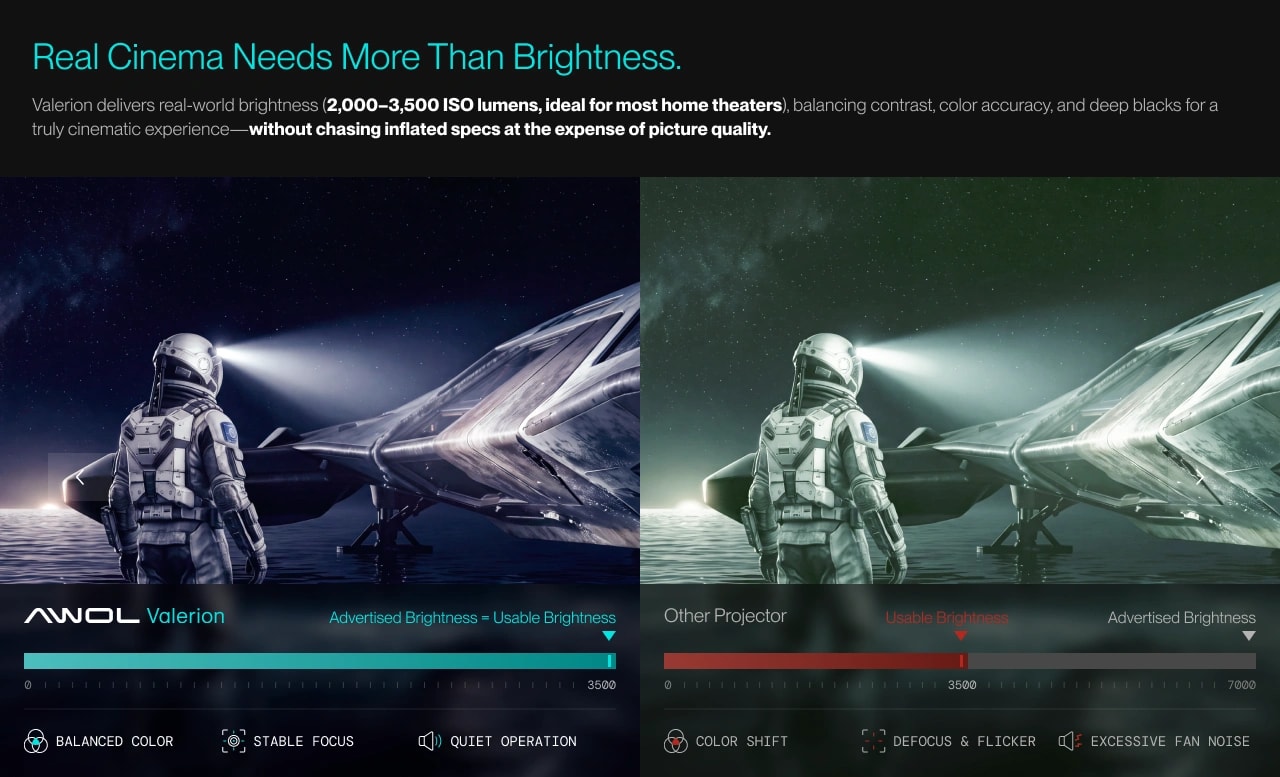
Peak Brightness Isn't the Same as Usable Brightness
Lumens are an important specification, but the conditions under which a projector achieves its advertised brightness matter just as much as the number itself.
Some projectors reach their highest advertised output in specially configured picture modes that prioritize light output over color accuracy. These modes can be useful in certain environments, particularly when ambient light is difficult to control. However, a projector's maximum output does not necessarily represent the brightness you will get when watching a film in a more carefully calibrated Movie or Cinema mode.
When you switch to a mode designed to deliver more natural colors and balanced image quality, brightness may fall. The size of that difference depends on the projector's light source, optical design, image processing, and picture settings.
This is why comparing headline lumen figures alone can lead to misleading conclusions. Two projectors with very different advertised brightness levels may perform much closer together under comparable viewing conditions. Conversely, two projectors with similar specifications may produce noticeably different images once color accuracy, contrast, and real-world settings enter the equation.
The more useful question is not simply, "How many lumens does this projector produce?" It is, "How much brightness can I actually use without compromising the picture?"
For home theater enthusiasts, this distinction is especially important because the most impressive image is not always the brightest one. A projector that produces a dazzling image in a showroom demonstration may not be the one that delivers the most convincing experience during a two-hour film.
AWOL Valerion takes a different approach to this comparison: advertised brightness should translate into brightness that is genuinely useful for watching content, rather than serving only as a peak figure on a product page.
When evaluating any projector, look for brightness measurements taken under clearly stated conditions, ideally alongside independent measurements of color accuracy and contrast. A meaningful comparison should account for both the amount of light reaching the screen and the quality of the image that light produces.
More Brightness Doesn't Automatically Mean a Better Picture
Brightness is only one part of image quality. The challenge is maintaining it without sacrificing the characteristics that make a projected image look natural, detailed, and cinematic.
Consider color accuracy. When a picture mode is optimized primarily for maximum light output, its color balance may shift, making whites appear cooler or skin tones look unnaturally green. A scene can look brighter at first glance while becoming less faithful to the original image.
Contrast presents another challenge. Bright highlights attract attention, but the relationship between those highlights and the darkest parts of an image determines how much depth a scene appears to have. If black levels rise and dark areas become gray, a bright star against a dark sky loses some of its impact. The same problem can affect nighttime cityscapes, dimly lit interiors, and films that rely on subtle differences between shadows.
Shadow detail is equally important. There is a difference between making a dark scene brighter and revealing the information contained within it. If the image processing or contrast balance is poorly managed, fine details may disappear into black or become washed out when the scene is brightened. Neither result gives you a faithful representation of the original image.
Then there is the viewing environment itself. A fan that becomes conspicuous during quiet dialogue can interrupt an otherwise immersive experience. Picture instability, inconsistent focus, or visible changes in color and brightness during operation can also undermine the benefits of a high-output light source. These issues do not inevitably follow from higher brightness; they depend on the engineering and operating conditions of the individual projector. That is precisely why they deserve to be evaluated rather than assumed away.
The important point is that brightness, contrast, color, detail, and stability are interconnected parts of the viewing experience. Optimizing one number does not guarantee that the entire image will improve.
A better home theater projector should not force you to choose between a bright picture and a beautiful one. It should deliver enough light for your screen and room while maintaining the tonal depth, natural colors, and fine detail that allow a film to look the way it was intended.
That is the standard worth applying when comparing AWOL Valerion with other projectors in the same price range.
How Much Brightness Does a Home Theater Really Need?
If maximum brightness is not the ultimate goal, what should you look for instead?
For many dedicated home theater setups, a projector in the 2,000–3,500 ISO lumen range can offer a practical balance between a vivid image and the demands of cinematic viewing. Within this range, there is room to produce a substantial image without making peak output the sole priority.
However, no single brightness figure is ideal for every room. The right output depends on screen size, screen gain, viewing distance, ambient light, and the type of content you watch. A larger screen generally spreads the projector's light over a greater area, while ambient light can reduce perceived contrast even when the projector itself is sufficiently bright. HDR content also places different demands on highlight performance than standard dynamic range content.
This means that a 3,000-lumen projector is not automatically better for every room than a 2,000-lumen model, just as a projector rated at 6,000 lumens is not automatically superior to one rated at 3,000. What matters is how the projector performs in your intended setup and whether it preserves image quality at the brightness you actually need.
For many movie-focused users, the more useful target is a projector that can produce a vivid, engaging image in a well-balanced picture mode—not one that wins a specification comparison under a single favorable setting.
AWOL Valerion's product positioning reflects this philosophy.
The AWOL Valerion Max is positioned in the 3,500-class brightness category, while the AWOL Valerion Pro 2 sits in the 3,000-class category. These models give buyers different brightness targets within a range designed around substantial home theater performance, rather than treating the highest possible output as the only meaningful measure of quality.
The distinction is important. You are not simply choosing between two lumen numbers. You are considering how much brightness your room and screen require, how you prefer to watch movies, and how that brightness works alongside contrast and color performance.
Instead of asking which projector has the highest number, start with a more practical question: Which projector can deliver the picture I want, in the room where I will actually watch it?
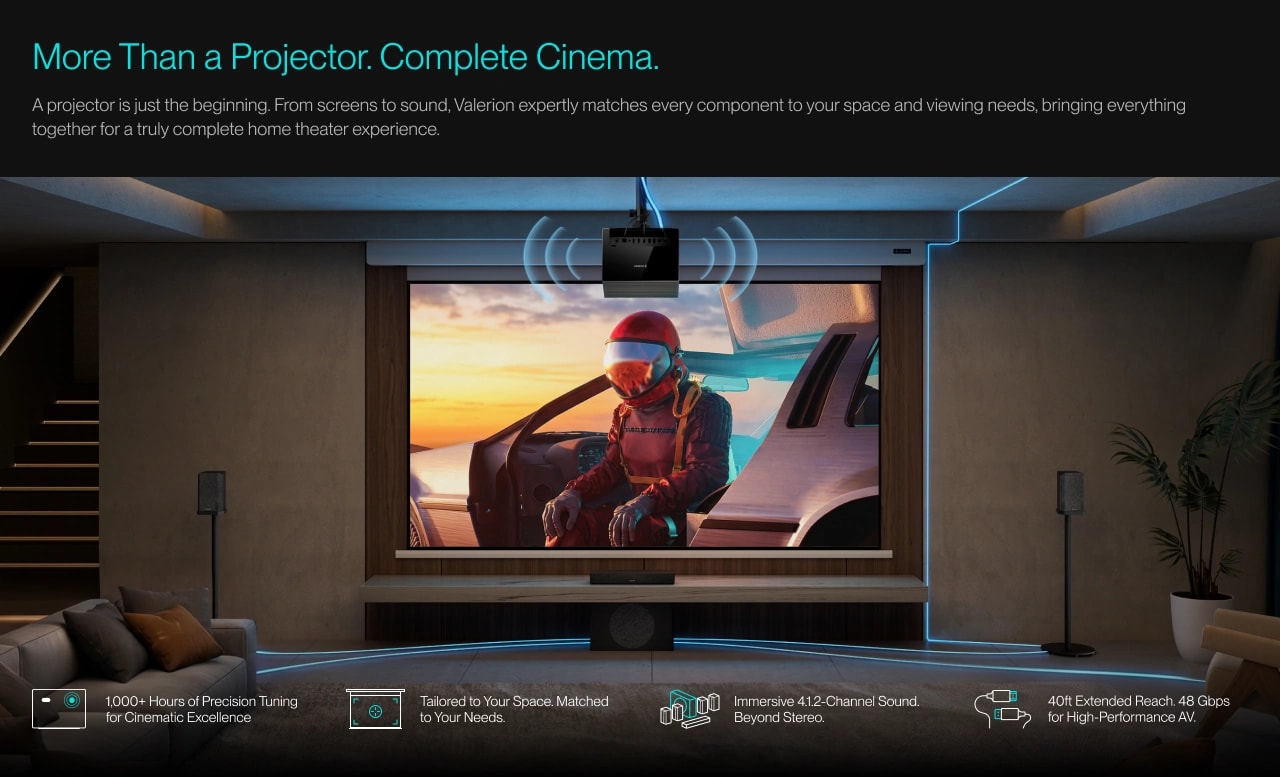
Beyond the projector itself, AWOL Valerion offers a complete home theater solution that brings together carefully matched screens, audio systems, and high-performance cables. Each component plays a role in creating a more immersive viewing experience: the right screen helps bring out the picture's contrast and color, a dedicated sound system adds depth and impact to every scene, and high-bandwidth connectivity supports seamless audio and video transmission. By bringing these elements together, AWOL Valerion helps you build a home theater tailored to your space and viewing needs, where picture, sound, and connectivity work in harmony for a truly cinematic experience.
How AWOL Valerion Balances Brightness with Picture Quality
Choosing the right brightness level is only the beginning. To create a convincing cinematic image, a projector must also manage the relationship between light and dark, preserve contrast across different scenes, and maintain a consistent picture as the content changes.
AWOL Valerion's picture-quality approach combines native contrast, Dynamic Iris control, and EBL™ image processing to address these challenges.
Native Contrast: The Foundation of Image Depth
Contrast is not just a specification to compare in a table. It affects how dimensional an image appears and how convincingly a projector reproduces scenes containing both bright and dark elements.
A bright highlight against a deep black background creates a different impression from the same highlight surrounded by gray. Likewise, a dimly lit room feels more realistic when the image preserves the subtle transitions between the darkest shadows and the illuminated objects within them.
Native contrast provides the foundation for this performance. Image processing can help manage difficult scenes, but it cannot fully compensate for a weak underlying contrast capability.
For movie enthusiasts, this matters because cinematic depth often comes from restraint rather than sheer brightness. The atmosphere of a nighttime scene, the texture of a dark jacket, or the faint outline of an object in shadow can all contribute to the sense that you are looking into a real space rather than at a flat image on a wall.
Dynamic Iris: Managing Light as Scenes Change
Films rarely maintain the same brightness from beginning to end. A sunlit landscape may be followed by a dark interior, then a scene filled with small highlights against a nearly black background. A projector that handles these transitions well can preserve a more convincing sense of depth throughout the film.
AWOL Valerion's precision-tuned Dynamic Iris adjusts how much light passes through the optical system as viewing conditions within the content change. The goal is to maintain the impact of bright scenes while improving the presentation of darker ones, without introducing distracting changes in perceived brightness.
This is particularly relevant to home theater viewing, where the lights are often dimmed and the audience becomes more sensitive to black levels and subtle tonal differences.
The benefit is not simply a darker black in isolation. It is a better balance between the bright and dark parts of the same image, allowing highlights to stand out while preserving the atmosphere and detail of shadow-heavy scenes.
EBL™: Bringing Bright and Dark Content into Balance
AWOL Valerion's EBL™ technology adds another layer of image management by dynamically optimizing the balance between bright and dark content. According to the product information provided, the technology has been refined over three generations, with the OTA 3 update offering three adjustable modes.
That adjustability matters because not every film, room, or viewer calls for exactly the same presentation. A dark science-fiction film, a brightly lit animated movie, and a live sporting event place different demands on image processing. Giving users options allows them to tailor the presentation to their preferences rather than relying on a single fixed setting.
Together, native contrast, Dynamic Iris, and EBL™ support a more complete approach to image quality. Brightness gives an image its light and impact; contrast creates depth; and thoughtful image processing helps maintain the relationship between the two as scenes change.
This is why AWOL Valerion's value proposition should not be reduced to a single brightness specification. The objective is to make that brightness work as part of a coherent picture—one that remains engaging not only in a bright demonstration scene, but also in the quiet, dark moments that define a memorable film.
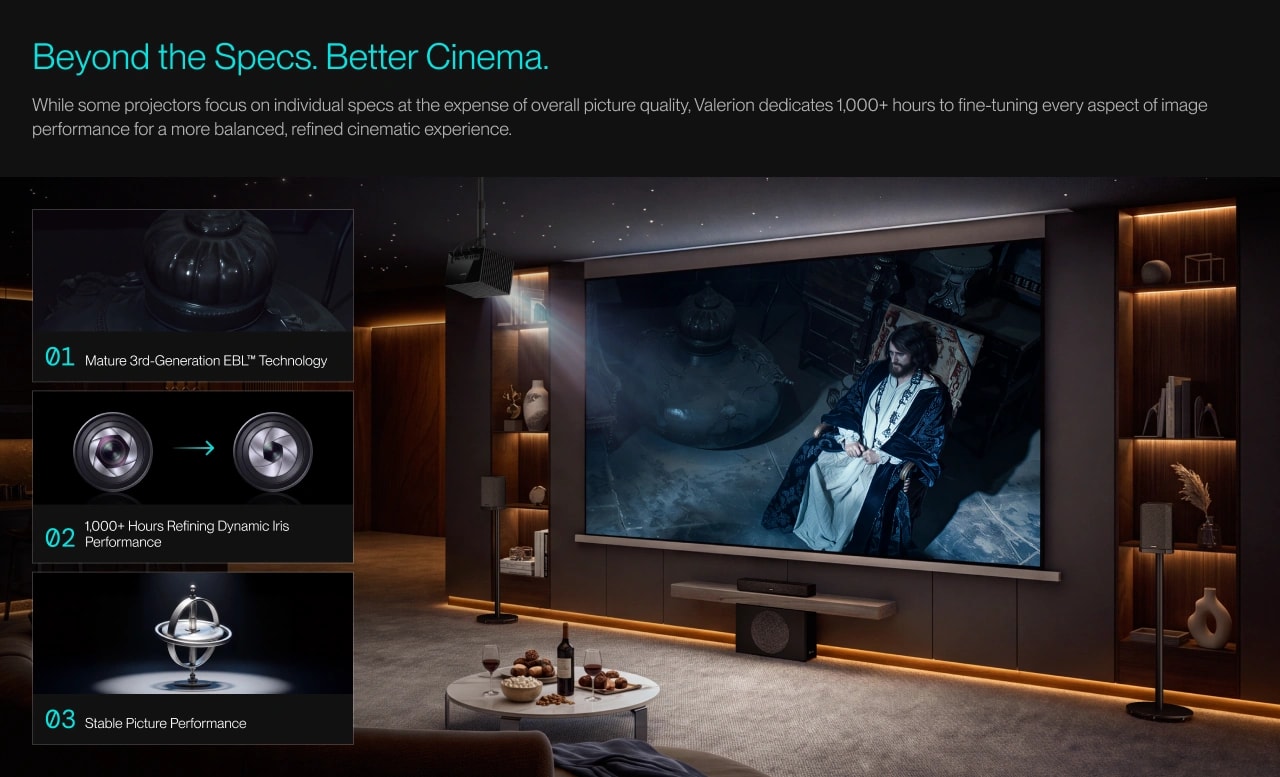
The Difference Becomes Clear When You Watch a Whole Movie
A projector can look impressive for a few minutes. A home theater projector has to perform throughout an entire viewing session.
During a movie, you encounter bright outdoor scenes, subtle skin tones, dark interiors, rapid motion, and moments when almost the entire screen is black. You may notice whether dialogue remains easy to follow, whether fine textures survive in the shadows, whether focus stays consistent, and whether the fan becomes distracting when the soundtrack falls quiet.
These details are easy to overlook when comparing product pages because specifications isolate individual characteristics. Real viewing brings them together.
AWOL Valerion also addresses other aspects of the cinematic experience beyond brightness and contrast.
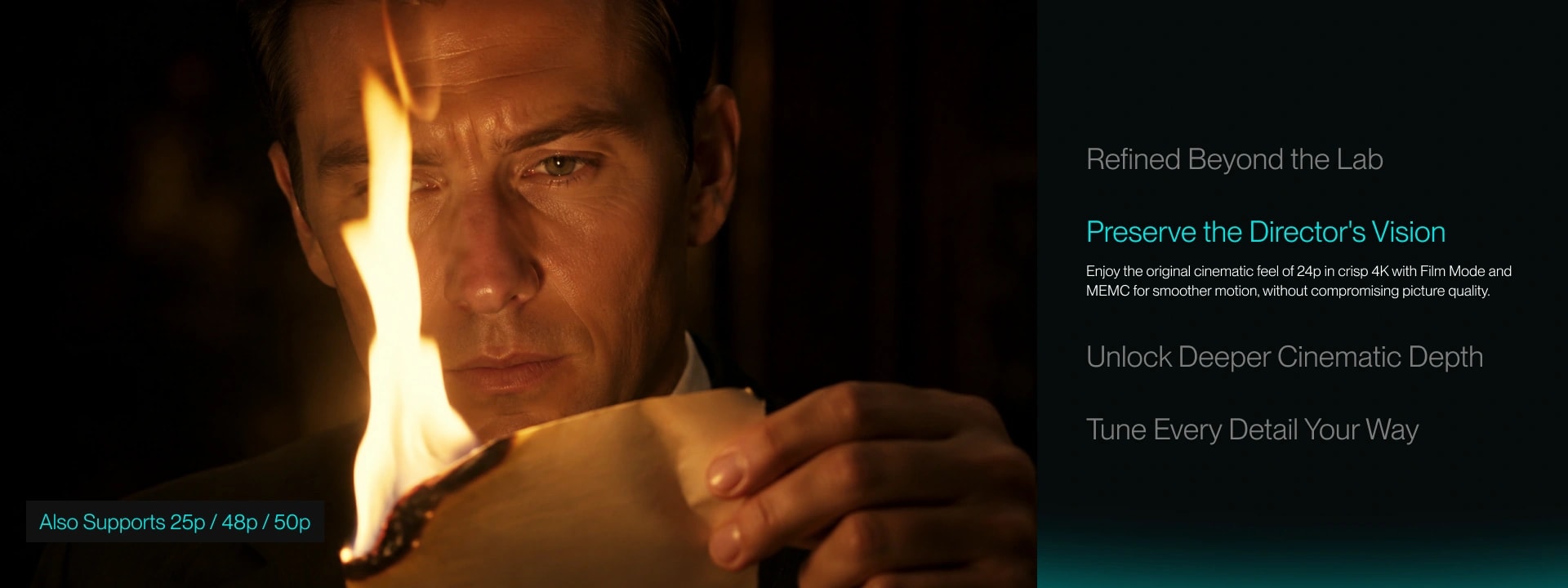
With AWOL Valerion’s 4K 24fps Film Mode and MEMC enabled, you can enjoy smoother motion while retaining full 4K resolution and fine image detail. Some projectors may reduce playback resolution to 1080p to achieve smoother motion, while others suffer from noticeable judder that disrupts the viewing experience. AWOL Valerion is designed to deliver both the clarity of 4K and smooth, consistent 24fps playback—so you can stay immersed in the film without compromising on picture quality.
AWOL Valerion's Anti-RBE technology is also designed to reduce the rainbow effect that some viewers notice with single-chip DLP projection. Sensitivity to this effect varies from person to person, so individual viewing experience matters. If you have noticed rainbow artifacts on other projectors, this is a feature worth evaluating in person where possible.
These considerations reinforce the same principle: the viewing experience is made up of several interacting factors. Brightness is essential, but it is not the whole picture.
When comparing projectors, look beyond the first impression. Ask how the image performs in Movie mode, how it handles difficult dark scenes, whether skin tones look natural, and whether the picture remains comfortable and consistent throughout a long film. Where independent testing is available, compare results obtained under equivalent conditions rather than relying exclusively on manufacturer specifications.
That is a more meaningful way to decide which projector deserves a place in your home.
AWOL Valerion Max or AWOL Valerion Pro 2: Which One Is Right for You?
Once you understand why usable brightness matters more than peak output alone, choosing between AWOL Valerion's models becomes a question of matching performance to your viewing needs.
The AWOL Valerion Max is positioned around 3,500-class brightness, making it worth considering if you want more light output within AWOL Valerion's home theater lineup. Depending on your screen size, room conditions, and viewing habits, that additional brightness headroom may be useful when you want a more vivid presentation or need greater flexibility across different types of content.
The AWOL Valerion Pro 2, positioned in the 3,000-class category, offers another route for buyers who want substantial brightness without making the highest output the defining criterion. For a dedicated movie room with controlled lighting and a screen suited to the setup, this level may already be a strong fit.
Neither choice should be made on the brightness figure alone. A larger screen, some ambient light, or a preference for brighter daytime viewing may influence which model is more suitable. Conversely, if you primarily watch films in a darkened room, you may find that other aspects of image quality are just as important as the difference in nominal output.
Think about your actual viewing environment first. Consider your screen dimensions, whether you can control the room's lighting, the content you watch most often, and how much flexibility you want for different viewing conditions. Then compare the models' brightness, contrast, image processing, and other specifications in that context.
The best choice is not necessarily the model with the highest number. It is the one that provides the right combination of performance for your space and your expectations.
A Home Theater Is More Than a Projector
Even an excellent projector cannot deliver its full potential in isolation. The screen affects perceived brightness and contrast; the room's surfaces and ambient light influence the image; and the audio system shapes how immersive the overall experience feels.
That is why it is worth thinking about the entire setup when planning a home theater.
AWOL Valerion's broader home theater offering includes matched screen options, immersive audio configurations, and signal connectivity designed to work together as part of a viewing system. The right combination depends on your room and budget, but the underlying principle remains the same: individual specifications matter most when they contribute to a coherent experience.
A well-matched screen can help the projector perform as intended. Suitable audio can make dialogue clearer and soundtracks more engaging. Reliable signal transmission helps ensure that your source equipment and display work together properly. And thoughtful setup choices can prevent a strong projector from being held back by the rest of the system.
You do not need to purchase every component at once to benefit from this approach. What matters is understanding that the quality of your home theater depends on how its parts work together, not just on the projector you place at its center.
So, Why Choose AWOL Valerion?
If your main priority is finding the biggest lumen figure for your money, a specification table may be all you need. But if you are choosing a projector because you want to enjoy movies, sports, and other content on a large screen at home, peak brightness is only the beginning of the decision.
You need enough light to make the image vivid in your room. You also need contrast that gives dark scenes depth, colors that look natural, details that remain visible, and image performance that holds up over an entire viewing session. Those qualities work together to determine whether a projector feels genuinely cinematic.
AWOL Valerion's approach is built around that broader objective: useful brightness supported by contrast technologies, adjustable image processing, and features designed to improve the overall viewing experience. With the AWOL Valerion Max positioned in the 3,500-class category and the AWOL Valerion Pro 2 in the 3,000-class category, buyers can start by identifying the brightness level that suits their setup and then evaluate the complete picture each model is designed to deliver.
The next time you compare projectors, look beyond the number on the box. Ask what that number means in the picture mode you will actually use, how the projector handles the darkest scene in your favorite film, and whether the image remains natural and consistent when the novelty of a showroom demonstration wears off.
Because the best projector is not the one that looks brightest on a product page. It is the one that makes you forget about the specifications once the movie begins.
Choose AWOL Valerion for the picture you want to live with—not just the number you want to compare.
Exclusive Welcome Benefit
Unlock Your AWOL Valerion Cinema Experience
Subscribe to unlock your game day guide and early access to seasonal deals

Points & Rewards

Member Pricing

Priority Support

Early Access
New subscribers receive a $100 discount code by email.
Discover More Insights